Wednesday, February 15, 2006
Back in the land of the almost alive
The conference was fun, anyway. It's a chance to catch up on friendships with like-minded people - "plant nerds," as the seed-testing guy called us. He described himself and his coworkers as "the lab geeks of the plant nerds." He gave a talk on seed testing procedures and regulations, and how native plant seed just doesn't fit the system. Boring? Not at all! He was so warmly engaging and self-deprecating, and he showed up the ironies of his work so well. Seed testing is done with reference to grade tables, which list particular crops and the standards for each. Crested wheat grass, an introduced species that invades native grassland and excludes other species, gradually simplifying the vegetation and reducing the depth and fertility of the soil profile, is a recognized crop species included in the grade tables. It's a crop, but definitely not something that you want to be planting in a native prairie reclamation project. Green needle grass, a native species widely used in seed mixes for reclamation, is not in the grade tables. So, if you send a sample of a native species - say, northern wheatgrass - for testing, the standard procedure would treat any crested wheat grass in the sample as "other crop," and any green needle grass as a "weed."
He got a good laugh with that example. He also described ways that his company will try to work within the grade tables, using alternative procedures, to give the best representation of native seed. For example, if that northern wheatgrass sample has a lot of green needle grass in it, he will look at grading it as a mix, instead of as northern wheatgrass. His name is Morgan Webb, and the company is Seed Check Technologies Inc., in Leduc, Alberta. The website gives a sense of that same warm-hearted, fun-loving spirit that Morgan showed in person. (A tip for navigating the website: no scroll bars appeared in my browser, but I found that I could just click somewhere in the text and then use the up and down arrows to scroll.)
I showed some of my winter botany photos at the members' slide night, but when Morgan mentioned that seed testers have to take 16-hour government exams and be able to identify roughly 2000 species by seed characteristics alone, well, I was humbled.
Speaking of winter, we've had a bit of snow here (just in time to give us some whiteouts and icy snowpack on the drive to Yorkton), but already the fields and ditches are going brown again. We're supposed to get a high of -18°C and a low of -33°C on Friday, but then right back up to near normal temperatures on the weekend. Normal would be a high of -7°C, but for most of this winter, it's been warmer than that. Darn, I'd take a week of -40°C nights, just to kill off some insects, but I'm afraid we aren't going to get it.
Well, if I can sit up and write this long, I must be feeling better. Time to get on with ordering garden seed. Yes, it's a little late, but not as bad as you might think. I see that our southern friends are already well into growing things, but we really shouldn't start here until around March 1st.
Six days till Garth gets home! I owe him another posting on his website, and I really need to clean up my clutter before I have to share the bedroom again. Okay. One feeble step at a time.
Thursday, February 09, 2006
Camping Stories
It was our honeymoon, over sixteen years ago. We didn't have a plan. No exotic hideaway for us, just a room at Kenosee for one night, and after that, the road. Funny, Kenosee is a very short way up the road from my hometown, but we didn't see any Arcola folks there. Instead, when we stumbled over to the Moosehead for some food, we encountered a fellow we both knew vaguely from the dorm at Luther College, U of R. He reminded himself of our names, found out why we were there, and sang out, "So, what did you guys do last night?"
When we packed up the debris from the motel room, we discovered some things missing, and some things extraneous, so we went back to the farm, where the relatives cooed over us and pressed lots of leftover food upon us. Then we made our escape for the second time, and drove from the Moose Mountains to Duck Mountain. We have lots of Mountains in Saskatchewan. I've noticed, though, that if you're not from Saskatchewan, you can't see them.
They assigned us to the overflow camping, which was a lovely meadow in the forest, and if I remember rightly, we had it to ourselves. We walked on the shore by the campground, swam at the main beach, and then decided to hike the trail between the two areas. It was nothing daunting; you might want to bring a water bottle. It roughly paralleled the road, but kept its distance, off in the woods. There was a movement up ahead - another hiker intruding on our idyllic wanderings? No, a bear. It jogged across our path and away toward the lake. I had never seen one at large, but this one didn't seem too terribly large; probably a young one. We consulted and hesitated and worried about mother bears before finally deciding that no more bears seemed to be coming along, so we could probably safely continue across the bear's back trail. Later at the main beach, I found a map that showed all the facilities, including the garbage dump. Aha.
After Duck Mountain, we picked another green spot on the map, Greenwater Lake, but I don't remember our stop there. I remember the narrow iron bridge at St. Louis, but I had to do some Googling just now to find the name of the town, and thus I discovered that a major archeological find was made just a few years ago during assessments related to replacing that bridge. Well, the find is exciting, I'm sure, but I'm sad about the bridge. Safety, convenience, progress. Sigh.
During my Google tangent, I also found a St. Louis ghost story.
But sixteen-plus years ago, we knew none of this; we just drove across the bridge, admiring the broad river below, and continued on our way to Waskesiu.
The overflow camping there was a totally different scene. Again, it was a grassy meadow, but this time jammed with camper trailers and tents so close together that their guy strings overlapped. We hadn't been keeping track of days, let alone noticing the impending August long weekend. How it occurred to us, I don't recall, but we came up with a solution: the backcountry.
We rented an aluminum canoe, and signed up for a campsite out on the west shore of Crean Lake. They warned us that the sites would be primitive, but we were delighted. We piled our car-camping gear and several grocery bags of foodstuffs into the canoe and set forth. It was about four in the afternoon.
The Hanging Heart Lakes were lovely, and Crean Lake was like glass stretching away out of sight. We paddled through the deep green reflection of the shadowy trees and easily found our campsite: three sites together, but we had the place to ourselves. The "primitive" facilities included an outhouse, a nice firepit with a grill, a supply of firewood, and my nemesis: a platform high on some trees, for storing food out of reach of bears.
It's not like I fell off it.
It's just that the tin wrapped around the tree trunks had deep grooves scratched in it.
And the place was so beautifully private.
We drove each other crazy with our half-remembered wisdoms about how to avoid leaving attractive smells around your campsite. If I recall correctly, Garth was fairly unconcerned, but I heard every little sound in that terribly beautiful silence, and the next day, the setting was somewhat less appealing to him because of the bear in his tent (me).
Sometime during our stay there, we took the canoe out on the lake in the moonlight, but all I remember of that jaunt was the mosquitoes. That and wondering if the bears would come to visit our site while we were away, and wondering if bears are fond of swimming.
That must have been the first evening. I don't think we would have stayed a second night willingly.
But in the morning, there were waves crashing onto the shore. We spent the day puttering around the campsite, watching the occasional motorboat as it bounced across the lake and sent up a burst of spray at each wave. That night I couldn't hear the little forest sounds over the roaring from the lake and the trees. I wasn't reassured.
Was it two nights, or three? All I remember is that Garth got anxious about being stranded by the wind for another few days, and being late getting back to work. He decided we should get up before dawn, when the wind should be at its lowest, and paddle out.
The wind was still high when we arose, but Garth was determined, and I was becoming panicky about the imaginary dark forms among the dark trunks of the great dark forest. Again we threw our hodge-podge of gear and groceries in loose bags into the canoe. We very briefly discussed a strategy for orienting the canoe relative to the waves, then dug in our paddles and went.
It wasn't a direct headwind, but we couldn't run with it, either, at least not until we cleared a rocky point perhaps a half mile off. Garth has always been strong for his size, and he's not small, either. I was perhaps a little more experienced than he with paddling, but he managed quite well in the stern, and the first little distance seemed mostly okay. There were moments when he felt he needed to reassure me, though. He told me, "Don't worry; if we capsize, I'll dive down and get some of our stuff."
I just kept paddling. The near-misses with oversized waves wore on my already frazzled nerves, and the shore seemed to be approaching faster than that point where we could clear the rocks and turn down the wind. Garth quit talking and paddled. And we paddled.
And we paddled.
And we made it.
The Hanging Heart Lakes were oh-so lovely.
We returned the canoe and signed out of the backcountry register, and headed for Prince Albert and a hotel.
When we recovered, we realized that we had quite a bit of our vacation time left over, so we turned away from our homeward track and went to surprise the relatives who, by this time, were gathered at Kananaskis in southwest Alberta for a family reunion. We made a stop in Calgary so that Garth could show me the wave pool.
Garth loves water. He once spent several hours swimming across a crater lake in Australia, and back, all by himself. I, on the other hand, had struggled to teach myself to swim during my years at university. The only time in my life that I ever loved water was yet to come, a few years later, when I discovered that pregnancy made me buoyant.
Anyway, the wave pool looked like fun. Garth took me in the shallow end, coaxing me deeper into the waves, and showing me how to drownproof. Then we went to the other pool, where you could sit on a ball suspended from a rope and swing out over the water and then let yourself drop in. That was fun too. Garth, bursting with the joy of water and the pleasure of sharing it with me, led me back toward the wave pool. "Let's go in the deep end," he cried, and off we went.
He went down the ladder first. I had got about halfway down when a wave caught me. Garth must have been closely watching my descending form, because it didn't take him long to get hold of me. I climbed on his head.
I had never felt that way before, and never again since. I knew I was panicking, and I knew it was pointless, but there was not a thing I could do about it.
Like I said, Garth is strong. He put me back on the ladder, climbed out after me, and calmed me down.
Then he stood back, looked at me, and said, "I guess if we'd capsized, I might not have been going after our stuff!"
Wednesday, February 08, 2006
Letting Kids Be
Those kids can be depressing. They are trying so hard to be something, but they're nothing at this point. It's so sad.I think he nailed it. They are "trying so hard to be something."
At bible study this morning we were talking about changes in the church, and wondering what has changed in the community and the world, that it has become so difficult to get people involved. A couple of things came out:
1) people no longer think that God is taking care of their lives; they make their own lives
2) family life revolves around an exhausting round of kids' activities
3) the time for an individual to take a place in the community has been pushed later and later in life. Whereas a child used to begin to find a place and a role as soon as he or she could lift a basket or a hoe, that time gradually moved to sometime when the child started thinking "I've had enough school, I'm ready to work." Around that time, they would begin to try to impress the elders of the community with their strength or their smarts. Now it's pushed off even farther, and community involvement is just another thing to add to a resume to try to get a scholarship. Everything is focussed on getting into college, and few students even begin to think about their place in a community until they're suddenly convocated and job-hunting and trying to learn to "network." (The effect on the church is that there is no continuity, from Sunday School through confirmation class to a valued role in the church community. After confirmation, the young people leave, and maybe, maybe, they come back to bring their own kids to Sunday School.)
With all the focus on "what will you be when you grow up?", there is a backlash saying "let kids be kids," which translates into a lot of entertainment and recreational events. But there is very little acknowledgement that kids want to be something, now, today. They want to be listened to, and they want to contribute. That is the great gaping hole in their lives, and sadly, many of them don't even know it's there.
Tuesday, February 07, 2006
And more of Garth's view
Another view of Nepal
I have only watched a couple of the videos. I am ambivalent about world travel. Yes, I'm ambivalent about Garth's travel. It's an ongoing point of strain between us; he wants to see far more of the world than he has to date, and he wants to see Australia again, but I feel almost no desire to see it even for the first time.
I believe there is far more travel going on than there should be, but I'm grateful when those who do travel take the time and effort to share the beauty and the realities of their experience with others. Thanks, Kaura.
Monday, February 06, 2006
*******
Update - don't miss Eleutheros' comments to this post, either. This is getting too easy - the commenters are doing all the work! Thanks, everyone.
Saturday, February 04, 2006
It's dark in here
*******
Update - well, whaddya know? The lights are back on in my little blog world. Why, I don't know.
********
Update #2 - and poof! The door slams shut and it's dark in here again. Two minutes later. Please do let me know whether you're having any trouble reading my blog, or not.
Friday, February 03, 2006
What is "selfish"? - Part 2
I recall my sister musing that, with all the modest lifestyles among her relatives, she might be the only one on either side of her extended family who was paying enough taxes to support the basic services relied upon by said family. Services like roads and schools.
She implied that we were all being selfish.
To avoid being selfish, then, we should all go out and earn more income (to pay more income tax) and buy more goods (to pay more sales tax).
That way there would be more money for schools to teach our children how to clean up the environmental messes we created while earning more income, buying more goods, and driving more often because we'd have such wonderful roads.
I guess it's clear that I don't think we're being selfish by living modestly. My point of view should come as no surprise.
Still, I wonder where the line is. I want to live in a society that maintains sufficient technological and industrial capacity to have dentists, steel roofs, and maybe even satellite imagery. I find it difficult to believe that I must eat takeout pizza rather than homegrown food in order to maintain that society, but I don't know where the balance point might be.
Obviously there won't be a simple answer. Yet as I think about it, I wonder if the answer at the individual level really is fairly simple. There are those who want us all to trust in economic growth as the answer, and they keep pointing out how effectively market forces balance supply and demand. If that's the case, then all an individual needs to worry about is choosing to demand the things that are really needed for life, and refusing to demand things that aren't. The market will take care of the rest.
What is "selfish"?
What they didn't tell me was the cost.
Why should I care? We have Medicare, and even if we didn't, obviously my estate wouldn't be picking up the tab for my generous act.
I care because a cost to the health system is a cost to my neighbours, my community, and my world.
Yes, but it saves a life!
Sorry, that's not a good enough argument. Fixing a highway embankment saves lives too, and if it does so at a lower cost, then it should have priority over the transplant program.
Well, okay, but that's easy to say if you're not the one on the waiting list for the transplant.
True, and I don't know how I would act in that situation. But I kept looking for information on costs and benefits of transplants, and as I looked, my thinking evolved. The more I looked (without success), the more convinced I became that I wanted healthcare cost information so that I could make advance decisions and directives, not for the fate of my organs after my death, but for the responsible treatment of my body while I live.
For example, I couldn't find any straightforward information on the full cost of having a kidney transplant, versus managing the disease in other ways, or accepting an earlier death. I did find out that transplant patients would face ongoing health costs associated with immune suppression to prevent rejection of the transplanted organ.
Now in case you're thinking I'm being incredibly callous, remember, I was thinking about what I would want to have happen if I myself should develop kidney disease.
I told Garth about these thoughts, and the idea of refusing a kidney transplant because the long-term cost of such medical intervention seemed irresponsibly high.
He told me I was being selfish.
I mentioned the discussion to a friend, and he agreed with Garth.
I don't.
Here is an analogy. Suppose I was adrift in a lifeboat with two plump people. I myself am on the scrawny side. We have a water purifier, but a limited supply of food. Our best estimate is that there is not enough food for all three of us to last until we reach land. My suspicion is that the two of them could survive together, but there is only enough food for one of me.
Now let's say that all three of us have spouses and children waiting back home.
If I don't drown those other two people to make sure I get home to my family, am I being selfish?
Thursday, February 02, 2006
Environmental Scare-Mongering . . .
Licia Corbella's doom-and-gloom article appeared in the Calgary Sun on December 11, 2005. She stated that in order to meet our obligations under the Kyoto Protocol, Canada has to reduce its greenhouse gas (GHG) emissions by 270 megatonnes (mt). She then reviewed figures from Environment Canada, presenting them as evidence that the target is impossible to reach.
In 2002, Canada's entire manufacturing sector spewed out 62.9 megatonnes.
Then comes the transportation sector, which includes all those planes, trains and automobiles, pipelines and Paul Martin's tax-exempt Canada Steamship Lines freighters.
Ground, park and dock them all and we would remove 190 mt of GHGs.
Combine those two sectors -- manufacturing and transportation -- and that adds up to 252.9 megatonnes, leaving us short by 17.1 megatonnes.
She goes on to raise the specter of billions of Canadian tax dollars flowing to Russia to buy emissions credits, because, she implies, it's obvious that we can't shut down our entire manufacturing and transportation sectors.
Let's back up to 1990. That's the base year for Canada's Kyoto commitment. Our target is to reduce our emissions to 6% below 1990 levels. Correct me if I'm wrong, but the way I remember it, Canada did have a manufacturing sector in 1990. Canada also had a transportation sector. If these sectors are the big baddies, obviously we shouldn't need to totally eliminate them to achieve a 6% reduction.
Check the Environment Canada figures for yourself, and see how cleverly Corbella has chosen her sectors. Obviously transportation has to be included, because everybody knows it's the other guy's SUV that's the problem. At 180 mt for 2002, transportation is a big part of the 719 mt total. A big part, yes, but where's the other 539 mt? Clearly it's not all in the manufacturing sector. But manufacturing is the perfect contentious target, vilified by those eager to assign blame for environmental problems, and defended by their opponents as the engine of our economy. Corbella knew exactly what she was doing.
She was scaring people into assuming that they must watch helplessly as government either turns Canada into a have-not country, or backs out of its Kyoto commitment.
In reality, where is the rest of the 539 mt total? For starters, it's in "Electricity and Heat Generation" at 129 mt. That refers to "thermal combustion-derived electricity" - such as the electricity that is powering my computer right now, that runs my refrigerator and my freezer and my washer and dryer and my Christmas lights and the lights that get left on when no-one is in the room. If I reduce my use of this electricity, it won't cripple the economy.
Where else? How about Residential [Energy Use], which refers to fuel combustion in homes, at 44 mt. Turn down your thermostat at night (I have to remember to put some slippers on when blogging after bedtime), invest in some weatherstripping and insulation, maybe upgrade some windows. How will that hurt the economy? Sure, if everybody did enough of it, maybe the demand for natural gas would level off. Drilling in southwest Saskatchewan might slow down a bit.
What about agriculture? We hear so much about belching cows. This appears in the table as "Enteric Fermentation," and it amounts to only 22 mt. Another 8 mt are attributed to "Manure Management." Meeting the targets doesn't mean giving up all our steak and milk. We might do well to look at our crop production practices, though. "Agricultural Soils" refers to emissions of nitrous oxide; this happens when nitrogen from fertilizers of various kinds goes partly into the air instead of the plants. The figures are estimated, with large uncertainties, but the value given is 29 mt. Then you have to consider emissions associated with fertilizer and pesticide production, and fuel combustion to run the tillage and harvest equipment; these figures are hidden in other categories, such as "Industrial Processes" and the already-mentioned "Transportation."
If you're running a total in your head, you know there's still a big chunk missing. The "Industrial Processes" that I just mentioned account for 51 mt. (How many of Corbella's readers would realize that there was an entire category separate from "Manufacturing," called "Industrial Processes"?) "Waste," mostly solid waste disposal on land, gives another 25 mt.
Of particular significance to southeast Saskatchewan, given our economic dependence on the oilfield and on coal-fired power generation, are the categories of "Fossil Fuel Industries" at 73 mt and "Fugitive Emissions" at 55 mt. Not only do we release GHGs when we generate power or drive our cars, we also release them when we produce the fuels in the first place. (In case you're wondering, "Fugitive Emissions" refers to things like spills, leaks, venting and flaring during oil and gas production, plus a much smaller amount of methane released from coal deposits during mining.)
I haven't covered all the categories. Most of the rest are relatively small; "Land Use, Land-Use Change" actually has a negative figure to allow for CO2 uptake during plant growth. As you can plainly see, there are a lot more areas to work on than just transportation and manufacturing. By choosing these two sectors, Corbella skilfully directed attention away from the areas where our own individual initiative could most quickly and painlessly make a difference. If we're merely trying to meet Kyoto targets, the picture is not nearly so bleak as Corbella paints it.
A much more serious criticism of the Kyoto Protocol is that it will merely slow the accumulation of greenhouse gases. Even if all the targets were met around the world, greenhouse gases would continue to rise. And even if we could somehow reverse that trend, and begin to reduce the levels of greenhouse gases in the atmosphere, we would still have a long way to go just to bring them back within the range where these gases have fluctuated over the last 650,000 years. We have already drastically altered the chemistry of our atmosphere, and as I have noted previously, climate change may be the least of our problems.
Not-so-news from Nepal
We are both longing for him to be home.
At the same time, we are both fearing it. We will have to work this stuff out. Not that we have built up enormous differences, but just that we have each found a comfortable way of existing over these last few months, and the reunion will require some adjustment. I've found my own way of relating to the kids. Sometimes Garth gets glimpses of it during a phone call, and sometimes he has a good suggestion, but other times I just suggest that if he wants to do the parenting, he can hurry up and come home!
For now, I am preparing by gently shifting my focus. Perhaps out of self-preservation, I had turned my focus away from him for a while just so I wouldn't miss him so much. I know he did the same with me; he told me he tried not to think about home too much, or look at pictures of us, or that sort of thing.
Now it is time to start including him in our plans again. Not only that, but to make him a part of my thinking as I go through each day. Right away I notice that I have let myself get far behind on posting his weekly columns on his web site. At first I was waiting for the newspaper to publish them, but then a whole month went by when I could have posted some, but didn't get to it. My apologies to his Mom and others who have been waiting.
No time like the present. That's a phrase that has been making me a lot more effective lately (thanks mum!). Today I posted Garth's Week 6 article, from way back in November, which appeared in the Carlyle Observer at the end of December. I plan to keep them coming every couple of days until we are caught up.
Tuesday, January 31, 2006
Tough Sledding
At the turning of the year, I wrote about the lack of snowmobiling action around here over the Christmas holidays. At that time, I reviewed the climate data from various stations nearby and concluded that a brown New Year's wasn't that extraordinary. Now here we are a month later, and still virtually no snow. The annual Snowmobile Rally organized by the Arcola Optimists went ahead last weekend, with posters proclaiming "We Have Snow!", but they had to trailer the sleds up into the hills where there actually was a bit of snow on the bush trails. There were only about a quarter as many riders as last year, from what I hear.
I'm also hearing comments from bloggers all over the continent about the mild conditions. Deb in Minnesota saw pussy willows in mid-January! Wondering what happened to our usual arctic high pressure systems, I thought to myself that maybe we've had them and just not noticed, because the arctic air is so warm.
Not so, according to this story from Yahoo News:
It's not like winter evaporated. It has just skirted the world's second largest country and focused its fury on other parts of the globe.
Arctic weather masses have left parts of Europe encased in ice. Greece has endured its heaviest snowfall in a decade. And an extreme cold snap across Russia sent temperatures plummeting to -40C and left dozens dead.
Oh dear. I hadn't heard anything about that. I did hear that there have been big disruptions in natural gas supply in parts of eastern Europe. That combination spells misery or worse.
Yet we go complacently along. I know that our home's heating system is doubly vulnerable, because the furnace won't run unless it has both natural gas and electricity. I've wondered about rigging up some sort of pedal-powered alternate drive for the fan, and a backup electrical supply if needed for the valve controls, so that we could at least have some heat as long as the gas supply was on. Then I get thinking that it might be simpler and better to just add a woodstove. I'd really like to rearrange the whole floor plan so that we don't have picture windows facing north and west, and most of the south wall taken up by an unheated porch. It just doesn't make sense for solar gain.
Then again, with the cloudy winter we've had so far, there wasn't much solar gain to miss.
***************
Update - Wayne has more about mild weather in North America, and the long-term context.
Sunday, January 29, 2006
Regional insufficiency
I realize that complete self-sufficiency is not necessarily of interest to anyone. You can make a great contribution to conservation without going anywhere nearly that far. You can make yourself much less dependent on the system, without cutting yourself off from it. Remaining somewhat connected, you can keep more involved in your community, and perhaps avoid drawing scorn or negative press for yourself and other self-sufficers by seeming too extreme. Perhaps most importantly, that last bit of change to become completely self-sufficient would presumably take much more effort than many of the larger changes you made more easily at the beginning. You may have better uses for that extra effort.
Having said that, it seems valuable to have the know-how for complete self-sufficiency preserved in living form across the wider community of self-sufficers. Maybe not everyone needs to be a blacksmith, but it would be good to know that there was a blacksmith around, not too far away, in case that skill ever became needed.
Thinking along that line, I noted that there seem to be several areas where self-sufficiency enthusiasts fairly consistently opt for manufactured items. I'm thinking of clothing (or at least cloth, needles, and thread), tools, and roofing. There are probably more, but those are the areas that come to my mind.
Does this bother anyone else? I love to sew, but I rarely bother because I can have second-hand or even new clothing for much less cost than the cloth to make my own. I guess between my Dad and my sister, there is probably enough skill and equipment to make a lot of tools, but again, the raw materials probably cost more than the ready-made tools. There are warning bells going off in my mind here, saying there has got to be some serious exploitation going on somewhere, for the finished goods to be cheaper than the raw materials. And if so, maybe these areas should be a higher priority in a self-sufficiency project than simple cost-saving per unit effort would suggest.
What would happen if there was a major collapse in the global economy, or some kind of trade shutdown for our country, so that we were forced to become more self-reliant? Obviously food would be an immediate issue. In the chaos, maybe the utilities that supply gas and electricity to homes would collapse too. So far, the popular self-sufficiency projects would be paying off. But what if the changes were more gradual, with changes in world trade patterns making all imports less and less accessible? Everybody would be scrambling to grow more food, but to do so, they would be needing tools. Everybody would be working a lot harder, and needing good practical clothes, and wearing them out in a hurry. How quickly would our domestic capacity to produce tools and textiles catch up with the demand?
I get the impression that tools and textiles are unpopular do-it-yourself projects because they take a lot of effort and skill. I've never given more than a passing thought to tackling either one, except that I'm curious about how my Scottish forebears used nettles for fibre for fine cloth. As for roofing, I think there are some accessible do-it-yourself alternatives available, but a good steel roof is worth it for the protection to your investment in the building structure, and for the clean water you can collect from it. Still, at times I've wanted to experiment with other roofing materials just to keep the options open.
All this time spent musing, when I could have been plotting the obvious steps to grow more of our own food this coming season, and make our house more energy-efficient right now. I think I've let my son fall asleep untended again, too. If you don't hear from me for a couple of days, let's hope it's because I've decided to actually get something done.
Saturday, January 28, 2006
Where to begin?
A few months ago a brother-in-law sent me something about a highly efficient small wood stove that gasifies the wood before burning the gases. I didn't get around to looking at it in detail, but it looked promising. Now via Kate, I find this article on using pelletized grass fuels, from R.E.A.P.-Canada (Resource Efficient Agricultural Production).
The grass part caught my attention. Just last night, I was thinking that my push toward self-sufficiency will have to incorporate some form of grass-eating livestock, because grass is what grows here. Then I got thinking some more, and realized that pelletized aspen wood fuel is another thing to look at.
Of course, the first thing to do is to fix up the weather seals around this house. No time like the present. Er, except I really have to plow through some piles of paper - arrgh! Well, while I'm sorting paper, I'll make a plan to reduce the amount that comes in here, and prevent it piling up. I wonder if I could pelletize it?
Update - I did some more reading on the R.E.A.P. site and found that the pelletizing process is just the familiar, large-scale, rather energy-intensive process that's used to produce feed pellets for livestock. It can also be done at a small scale, but with the energy involved, why bother? I also discovered on the R.E.A.P. site, the Mayon Turbo Stove, which uses rice hulls or other crop residues directly as fuel. That makes a lot more sense. I'll be reading some more. A plain old woodstove would be fine, but I'm interested in this gasification process that (according to the reports I've seen) burns the fuel more completely, getting more heat with less smoke. If you're using local fuels sustainably, your greenhouse gas emissions are balanced by new fuel growth regardless of the efficiency of combustion. But more heat with less smoke could help to keep the neighbours friendly, and it would also mean less work gathering fuel!
Wednesday, January 25, 2006
Reason unbound
The blog where Kate found reference to this study, Crumb Trail, looks intriguing. From what I've read so far, this author seems to be making an effort to keep reason free of the fetters of emotion. I could feel my own emotional reactions kicking in as I read the post about fertilizer and organic farming, but the exercise in patient listening was rewarding.
Another busy day for me: no more blogging until . . . until . . . tomorrow.
Tuesday, January 24, 2006
I Got Out Alive
Did you miss me?
It wasn't that bad, really. I would have been back sooner, but the job just didn't seem complete until I'd washed all the newly liberated storage containers.
Election/Curling Report
I can see forgetting to vote because you're curling, but forgetting to curl because you're counting votes?! What's this country coming to?
****
p.s. I've been having too much fun lately. No more blogging until I clean out the fridge.
Monday, January 23, 2006
I - hate - Mondays;That's Ruth at lunch time - more or less a direct quote. I think I tucked the last line into place from something she had said a few minutes before. Poor kids can't even express their sheer grumpiness without getting their words turned into doggerel.
Mondays I - hate!
I'm just a little grumpy,
and plus I'm gonna be late!
But I told her I was posting it, and she said "Awesome!" as she raced out the door for the afternoon at school. Today she won't have to go to Carlyle after school for band practice (that's "Division Band," made up of students from Stoughton to Redvers and north to Wawota). It was cancelled due to exams. Instead she has a practice with the Pathfinders, of a special, surprise dance number for Robert Burns night (Wednesday at the Legion Hall), and then a bit of time to do any homework and make sure her boots and uniform are ready for Cadets this evening. Most of her Mondays are marathons. I keep urging her to ask her teacher for the Monday assignments in advance, so she can get ahead on the weekend. But I have to admit, if it were me, I'd probably quit something.
You know the stereotype about mothers reminding their children to do their homework, bring home notes from the teacher, take their mittens, and so on and on? With Ruth and me, it's just about reversed. She's always checking ahead to make sure I'll leave room in the schedule for the homework, sign and return the school notes, buy the mittens, and so on. If I were inclined to be smug about my adulthood, that kid would cure me quickly.
Winter Botany #6
I'm so conflicted. I just love words.
Friday, January 20, 2006
"Things are heating up in Nepal..."
Garth confirmed Dad's observation. He phoned to reassure me that he was okay, safe in his hotel for the time being, in case I had seen news of the day-long curfew imposed to thwart a mass demonstration against the king.
A fine time for things to heat up, just when we've started counting down the days to Garth's return. He assured me that he can get special police permission to travel if there's a curfew when he needs to get to the airport!
I can't begin to imagine how it would feel to watch the conflict escalate, if Nepal was the only home you had ever known.
Thursday, January 19, 2006
Navigable waters
People in Saskatchewan . . . . particularly scoff at the idea of Fisheries and Oceans having jurisdiction over some drainage ditch just because a canoe could navigate it for two days each spring.On the face of it, yes, it's scoffable. However, I have no problem with a department called Fisheries having jurisdiction over a creek that is vital spawning habitat for the fish that my neighbours like to catch down in the Alameda Reservoir. Moose Mountain Creek is navigable by canoe for a few days in spring, if you're not afraid of riding the current right into a barbed wire fence. In a wet year, you can navigate sections of it right through the summer, although you may do a fair bit of wading and leave some of your craft's gel coat on the rocks. I need to get my own canoe, a cheap rugged one, to keep on exercising my navigation rights.
I'm not surprised that people turn away and scoff as soon as they encounter "Oceans" and "navigable." We tend to look at our little creeks and sloughs and assume that they are insignificant little runts, compared with the beautiful Columbia, the magnificent Mackenzie, the crucial St. Lawrence, or even the smaller rivers that grace our prairie cities. And yet, when you think of it, our little creeks and sloughs are the only surface water we have. In our dryland climate, where the farmers say we are never more than two weeks away from a drought, these tiny ribbons and potholes of moisture are vital to nearly all our wildlife. Nevertheless, most of us seem to have dismissed them from our minds and from our attention ever since we finished being curious children, and as a result, they are profoundly misunderstood.
Last season, I discovered the lure of the creek crossings, something I had missed as a child growing up back in the hills. I began spending quite a bit of time down there with my kids. One day my daughter and I were enjoying the shallow spill of water over the concrete crossing, a mile east of the 604. There are culverts through the crossing, but when the water is high, the current is too much for them, and some of the water flows over top. We were standing at its edge, watching the froth and the reflections of the sunset, when a neighbour came along with her sandwich and beer for a picnic supper. She and I got chatting, while Ruth continued to watch the creek. Suddenly she squealed with alarm.
Something was writhing in the edge of the water. Ruth's gut reaction was that it was some kind of octopus, just in front of her toes (hence her shriek); but it turned out to be a bunch of suckers stranded in the rocks against the downstream side of the crossing, right next to the powerful outflow from one of the culverts. The neighbour reached into the foaming water and caught one to show us up close. She talked about how much fun it is to fish, and invited us to come along when the local chapter of the Wildlife Federation organized a trip to the reservoir on "free fishing day." Then to my amazement, she commented about the "stupid fish, trying to go upstream." She seemed to think that the good big water was downstream, so of course these big fish should be trying to get there.
I explained that the fish come upstream to spawn, way up into the Tecumseh pasture and beyond. The fry find plenty of food and shelter all along the shallows of the creek banks, and gradually work their way back down to the reservoir as the water drops later in the season. During the spawning run, when the adult fish coming upstream reach the crossing, their way is barred if the flow through the culverts is too strong to swim against, and the flow overtop is too swift and shallow.
The neighbour was intrigued, and we decided to help the fish she had caught, by releasing it on the upstream side. It darted off toward the depths, got caught in the vortex over the culvert intake, and went downstream. Stupid fish. Mind you, I imagine that if a fish caught me, held me underwater for a while and examined my form, and then released me on the opposite bank, I just might stumble back into the drink.
If you have read about our canoe adventures on the creek last season (see links above), or if you've spent any time studying the creek yourself, you'll know that there's more than suckers living in it. I still remember those quiet young pike, and the painted turtle hurtling away like a thrown discus. That little creek just down the road is important for fish and wildlife, which in turn are important for many people in this area. To my mind, the question is not whether the creek should be protected, but how.
Fisheries and Oceans might be the wrong department; perhaps they should focus on the big waters with commercial significance, and let the Environment Department take care of the watersheds that feed those big waters. That's okay with me as long as the different departments recognize and value their interdependence.
Perhaps both these departments are at the wrong level of government to be protecting our creek. Personally, I would really like to see our Rural Municipal Council take an active interest in managing and protecting our surface waters, rather than being in conflict with the environmental regulators. I think it could happen, but it would take initiative from local people, deciding to learn more, talk to their neighbours, look for new solutions, and work with other government bodies to get support and cooperation instead of resistance and top-down across-the-board rules.
This brings to mind an ironic case I saw, on an oil flowline project, where the planners made it a priority to choose the best site for a river crossing and thus avoid trouble with Fisheries and Oceans. As a result, they became inflexible about the rest of the project, and refused to consider changing the route to skirt a large tract of native prairie on the valley slopes above.
It's easy to talk about what would be the best way to organize our government responsibilities, but the reality is that they are shaped by a long history of incremental change. Government terms of office are usually too short to make big changes. There is a legitimate push to minimize new legislation by finding ways to adjust existing programs instead of adding new ones. Unfortunately the end result is a complex web of regulations and programs which may work fairly well, except that at face value they can appear absurd and inspire scornful hostility from the people they were originally intended to serve. Then elitism sets in, with those who understand the workings and the history becoming dismissive or adversarial towards those who just want to make things work here on the ground.
Water issues are confounded by the fact that water pays no heed to boundaries and property lines. In the U.S., the Supreme Court is considering the jurisdictional reach of the Clean Water Act. From the Environment News Service:
In October, the Supreme Court agreed to hear these two cases challenging the definition of federally protected waters. In both cases, the developers are arguing that they can pollute - even destroy - the waters at issue without a Clean Water Act permit. They argue that their right to pollute is protected by the U.S. Constitution.
[. . .]
Protection of tributaries was fundamental federal law long before the 1972 Clean Water Act, dating back at least to the 1899 Refuse Act, which barred discharge “into any navigable water of the United States, or into any tributary of any navigable water from which the same shall float or be washed into such navigable water.”
"Navigable waters" is an old, old phrase. It has a long and wide history of use as an organizing concept, to decide which waters are significant beyond the property within which they lie. We need concepts like that as baselines, as starting points for common understanding. We also need willingness and initiative to go beyond the baselines to protect the landscapes and living things that we hold dear.
Sadly, right now it seems that we don't even recognize the treasure winding through the pastures and fields just outside of town.
Tuesday, January 17, 2006
Winter Botany #5
is blue grama grass, Bouteloua gracilis. It's a tough little survivor, often found on the drier hilltops and ridges around here, and forming a larger component of the short-grass prairie that occurs farther southwest.
The seed heads are very distinctive, like little combs or thick downcast eyelashes. I'm trying not to get into heavy terminology here, but it is really tough to describe the intricate flowering parts of a grass without using special words. Please take a deep breath and bear with me; I hope you will discover that you, too, can tease useful information out of the apparent gobbledygook of a systematic description in a flora. Here is the description from the Flora of the Great Plains (don't worry, I'll translate):[for grama grasses in general:] Inflorescence consisting of 1-many spicate branches; spikelets sessile in 2 rows on one side of each branch rachis; each spikelet consisting of 1 perfect floret below 1 or 2 rudimentary florets, disarticulating above the glumes; . . .Ahem.
[. . .]
[for blue grama grass in particular:] Inflorescence with 1-3 curved branches, each branch persistent, 14-30(40) mm long, bearing numerous spikelets; . . .
An "inflorescence" simply means a flowering portion of a plant. Well, that may be an oversimplification, but it will do to be getting on with. Going back to an earlier post where I discussed daisies and dandelions and such: in those plants, one flower head is an inflorescence. It consists of a dense cluster of tiny flowers, and it may be only one inflorescence among many on a single plant. The term "inflorescence" draws attention to the arrangement of the individual flowers and other structures that go with them. Of course, in winter, we're not looking at flowers, but many of the parts remain in basically the same positions in the seed stage. Now before I do any more translation, I'll blend the above statements into one concise description of the flowering portion of a blue grama grass plant:
Inflorescence with 1-3 curved spicate branches; each branch persistent, 14-30(40) mm long, bearing numerous spikelets; spikelets sessile in 2 rows on one side of each branch rachis; each spikelet consisting of 1 perfect floret below 1 or 2 rudimentary florets, disarticulating above the glumes; . . ."Spicate" just means spike-like, but we don't call it a spike because that term is reserved for the very simple arrangement where all the flowers are in one long cluster. In this case, the cluster may be all in one branch, or there may be several branches (which look like separate seed heads, but are all parts of a single inflorescence). Picky, aren't we? But with the hundreds of possible variations in different species, we have to be picky if we're going to communicate at all. So, when you look at the little comb above, you're looking at a spicate branch of the inflorescence.
"Persistent" means they don't fall off. Plants have all sorts of variations on the theme of dropping seeds, and each species has its own particular way of falling apart.
". . . bearing numerous spikelets . . ." Ah, more spiky stuff. You might think that each tooth in that little comb is a seed, but it's not. It's a seed plus other little parts attached to a tiny side branch. It's a spikelet: a "small or secondary spike." Recognizing these tiny sub-clusters of flowers (or seeds) is crucial to deciphering descriptions of grasses.
"Sessile" means "without a stalk." The spikelets are tight to the branch rachis. What's a rachis? It's the longitudinal support up the middle of a spike or spicate branch or such like. Basically the branch rachis is the branch itself, but the word "rachis" helps clarify where the spikelets are attached: along the branch, not at its tip or on side branches or anything fancy like that.
Speaking of a rachis, the description mentions that the spikelets are attached "in two rows on one side of [the] branch rachis." This is important. This is what makes blue grama so distinctive in appearance that you don't really need all this description - you can just look at the picture and say, "I know that plant!" (But then there's hairy grama, which I've never seen, or at least, never noticed that I was seeing, which differs from blue grama by having the "rachis of [the] spicate branch projecting beyond the terminal spikelet," besides being just a little more hairy where the leaves meet the stems. . .) Anyway, notice that all the spikelets are crowded to one side of the spicate branch; that's what creates the appearance of a little comb.
When it says, "each spikelet consisting of 1 perfect floret. . ." this is where I say, "Bother. That stuff is too small to see anyway." I do have a dissecting scope, and I'm not afraid to use it, but we already know this is blue grama grass. I won't get into the minute details of individual grass flowers (or florets) today.
However, that last bit about "disarticulating above the glumes" is interesting, and it's something that you can easily check in the field without picking a plant, rushing home to your dissecting scope, and then finding out that you picked something rare. First, "disarticulating" means coming apart at the seams, er, joints. We're back to the topic of how plants fall apart. "Glumes" are bracts found at the base of a spikelet. "Above" means - wait, you do need to learn this word - "above" means farther from the roots, closer to the outermost tips of the plant. In the case of blue grama, it usually doesn't mean higher off the ground. The spikelet dangles, so it's closer to the ground than the glumes where it attaches, but we say the spikelet is "above" the glumes. When it falls off, the glumes remain attached to the branch rachis. Here is an inflorescence (centre of photo) with two spicate branches, and all the spikelets fallen, so all that remains are the slender glumes like a row of ribs.

I've omitted a good deal of additional detail from the description, where it discusses how many nerves are in each glume, and what sort of awns are found on the parts of each floret - like I said, "Bother." But if I keep talking about grasses long enough, you're going to hear about the lemma and the palea, and I'll have to admit that you don't absolutely have to have a dissecting scope to find them; a hand lens and some patience will do.
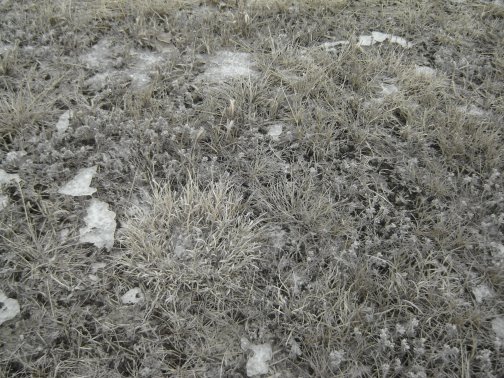
Whew! Thanks for bearing with me through all that. Now we'll go back to some straightforward general-appearance qualities of blue grama grass. As you've probably noticed, it's usually a low-growing plant. Even the flowering stems are rarely more than about 30 cm tall around here, and the leaves are much shorter, forming a curly mat on the ground. The mat creeps outward in an expanding circle by short rhizomes (underground stems). Here is a rather small plant:

(the pale circular tuft below and left of centre). The silver-gray cottage-cheesy looking things behind it and to the lower right are mowed-off stems of pasture sage. (How do you like my botanical description for that plant?) The dark stuff showing to the right of centre is not soil showing through. It's a dried up growth which my intuition says is Nostoc, a nitrogen-fixing blue-green alga, but don't quote me on that. Feel free to correct me.
Here is another blue grama grass mat (on the left). Note the strongly curling leaves. Each one is only 1-2 mm wide. I suspect that the fine leaves and stems on the right belong to a dryland sedge species. What's a sedge? Well, for the most part, sedges are easily mistaken for grasses (unless you know what to look for). I say dryland, because sedges in general are known for their affinity for wetlands and damp habitats, but in our area there are just a few sedge species that have the opposite preference. You find them on those dry ridges and hilltops, along with blue grama grass, and growing only 5 or 6 cm tall. I've heard it said that short-grass prairie might be more properly called "short-sedge" prairie. As for the details of what to look for in a sedge, well, I think I'll leave that till I can catch one flowering in early, early spring. Wish me luck. This year, it looks like it could be tough to tell exactly when spring is.Next in the series: you'll have to wait and see which way the muse takes me. Will I continue digging through my photos of grasses, or probe into the history of that vacant lot? Why so many native plants there? (Blue grama grass, sedge, prairie sage, and others I haven't mentioned yet.) Is it actually a degraded remnant of largely unbroken prairie sod? Or is it a once-disturbed but long-untouched piece of ground that was recolonized while there were still such remnants nearby? What part does it play in the ecology of our little townscape? What might its future hold?
Saturday, January 14, 2006
Winter Botany #4

A little before Christmas, the dog and I paused somewhere in this vacant lot. She was checking out some scent or other, and instead of urging her along, I lingered. I don't remember why; perhaps I was stretching out the time before I had to face the chores at home again, or more likely, I was vaguely hoping that some friend would just happen by, if only I stood there long enough.
I looked down, and there at my feet was a friend indeed.

I've got lots more to say about this friend, and about the not-so-vacant lot, but I've decided to be a friend to myself and quit the midnight blogging. I've also invited some dear friends to visit tomorrow, so it might be a couple of days before I give you all the details. Meanwhile, any guesses on the identity?
Friday, January 13, 2006
Winter Botany #3

Makes me wonder why it took them so long to invent Velcro.
That's wild licorice, Glycyrrhiza lepidota, native to this area and found through much of the Great Plains. Yes, it's a close relative of the ancient herb known as licorice, according to this informative page. Apparently the roots are the sweet part, eaten raw or baked. I haven't tried them, but I am quite curious, because I love licorice candy.
In terms of broader relationships, it's a member of the Bean family, or Fabaceae. There's not a lot to see here to tell you that, except that if you brave those little hooks and cut through the bur, you'll find that it's actually a pod with hooks all over its shell. I am realizing that in winter, I do a lot of my ID just by sheer familiarity.
And yes, in winter the whole plant is indeed a rich red-brown. It jumps out at you from its backdrop of pale dry grasses.

Like all bur-bearing plants, it seems to literally jump out at you, even when you pick your way past.
That brings me to the other part of today's sticky topic: gumweed.

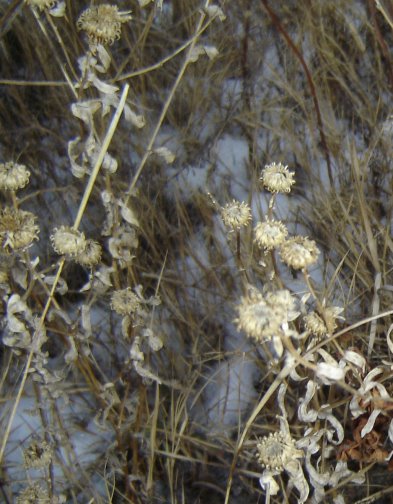
I learned a new word today: squarrose, meaning "with parts spreading or recurved at the end." And recurved means "curved backward or downward." Now take a close look at the heads of gumweed, or Grindelia squarrosa.

See the little curls around the edge of each head? Those are bract tips, curling out and down. In summer, this plant has bright yellow "flowers" which are actually composite heads of tiny florets. Such heads are typical of the plant family formerly known as Compositae (now called Asteraceae). Think of a dandelion; from one dandelion "flower" there suddenly appears a dome of hundreds of tiny seeds, each of which formed from a single floret in the dandelion head. Gumweed "flowers" look a bit like dandelion "flowers," except that each has a definite central disc with rays around it, like a daisy (also a member of the Asteraceae). Each ray belongs to a separate floret, and the central disc is made up of tiny florets also. Think of a sunflower; each seed forms from a separate disc floret.
Those of you farther south in the Great Plains may see other species of gumweed, but G. squarrosa is the only species found around here. The "weed" part of its name is very apt, since it is often abundant along roadsides and railroad grades, or across the less-used parts of industrial yards and gravel pits. It is native here, though, and sometimes provides a patch of colour just above a slough margin in a pasture.
The "gum" part of the name is even better. The bracts of the heads are so resinous that even in deep winter, or into the next growing season, the heads on a dry old plant will still feel gummy to the touch.
That concludes today's sticky topic. I have a T-shirt from the Native Plant Society of Saskatchewan, with illustrations of numerous burs, and a caption that says, "Stick with native plants."
Speaking of the NPSS, the annual general meeting and conference is coming up, February 9th to 11th in Yorkton. There will be speakers about climate change, invasive plants, seed testing and grading, and conservation programs. There will also be workshops on identifying weeds, identifying our native orchids, and botanical linedrawing. There's also a member slide show that's always fun, and of course there's the usual great food and great people. The registration brochure is here (pdf).
Thursday, January 12, 2006
Winter Botany #2
A couple of you commented on the common plantain, saying you were glad to be introduced to a familiar neighbour. I immediately started back-pedalling in my mind, wondering how many different plants might look superficially similar. To paraphrase a Bertrand Russell quote that Madcap posted yesterday: The trouble with getting to know plants is that beginners are recklessly confident, and more experienced people are tediously cautious.
I hope I don't get too tedious here.
It just happens that, on my quick walk with the camera yesterday, one of the other plants I spotted was Triglochin maritima, or seaside arrowgrass.

Mind you, I should confess that the specimen I spotted yesterday was more distinctive than this one.
It also happens that as I was walking home last night with the groceries, I kicked away the snow at the base of what appeared to be a plantain spike, and didn't find any leaf remains at all. Full of doubts, I went back out today and found the plant I had labelled "common plantain" in yesterday's post. Sure enough, under the snow, I found what I had expected to find.
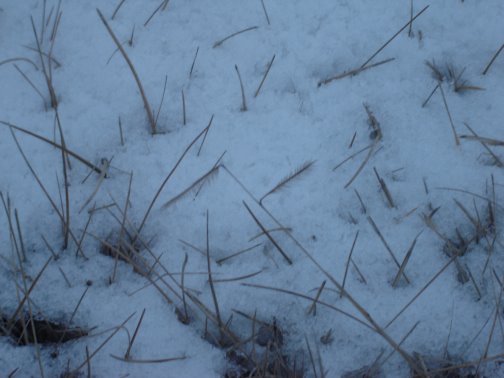
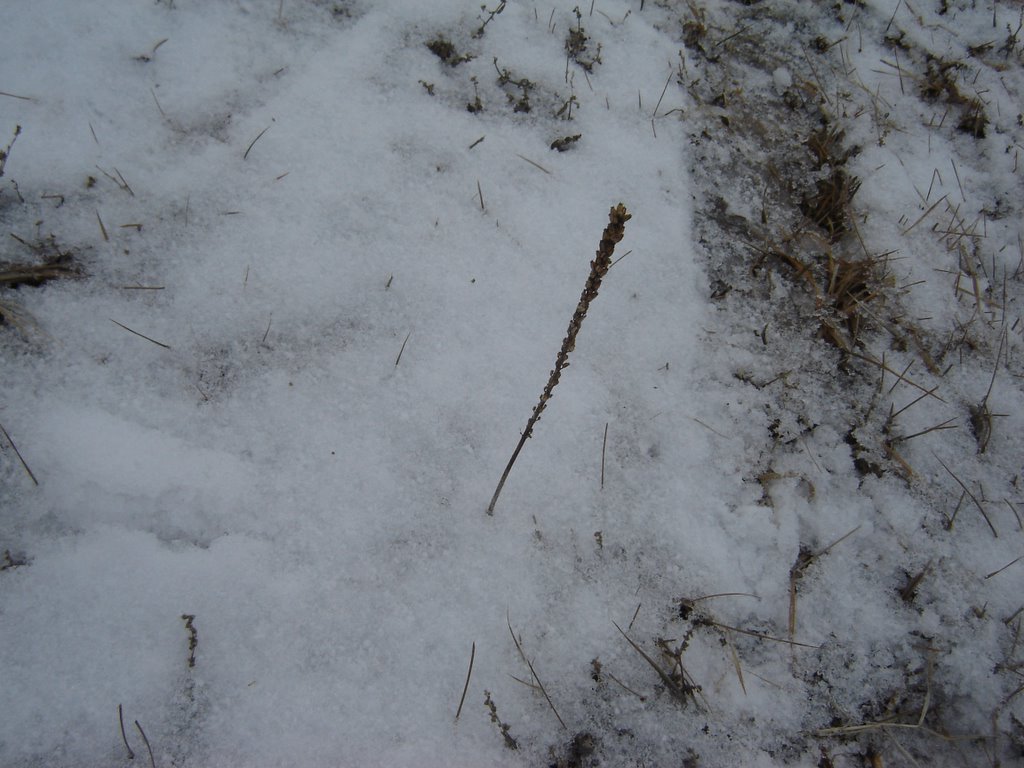
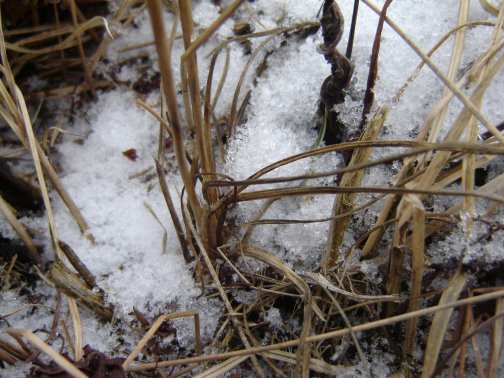
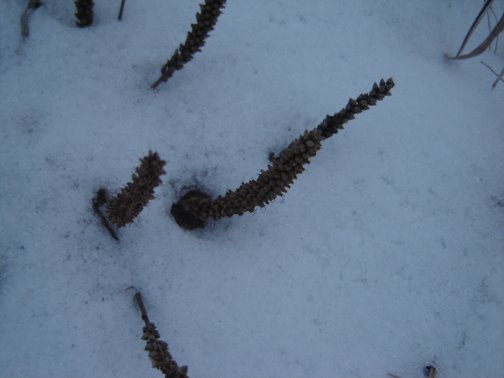
Large, broad, oval-shaped leaves (or what was left of them). All the leaves and spikes arise from one central point (the crown). You can see part of the outline of one leaf just below the centre of the photo. Its point of attachment is hidden in the snow to the right.I also got a bunch more photos of the seaside arrowgrass. I'm not happy with the focus and resolution of these, but together I hope they give you some sense of the plant. It's hard to be patient with the camera when it's below freezing, and breezy. Mind you, for January in these parts, I can't complain!

This long slender cluster of seeds is called a raceme. In this case, it's a spike-like raceme. It differs from the spike (which we saw in common plantain) by having the seeds on little stalks, instead of attached directly to the main stalk. In the right-hand image above, showing racemes with most of the seeds gone, you can see the little stalks that supported the seeds.
Here is the seaside arrowgrass plant that I spotted yesterday:

(It's the straw-coloured raceme front and centre.) If you saw a tall specimen like this, you probably wouldn't mistake it for common plantain. (Note to self - include a familiar object in photos for scale.) The base of the plant (just left of centre in the image below) is very different from common plantain.

Instead of large flat leaves, seaside arrowgrass has long slender grass-like leaves. (There are three clearly visible, all extending almost horizontally to the right.) In fact, this plant is much more closely related to grasses than it is to plantain. BUT - before you get thinking that this is simple, there are some other plantain species that have linear leaves!
Why bother learning all this? Well, a chewed leaf of common plantain makes a nice poultice for itchy insect bites. Seaside arrowgrass is poisonous to livestock (although there's rarely very much of it, and in a healthy pasture, livestock will probably avoid it).
Also, the more you learn, the easier the learning gets.
The more you learn about the ways plants are related, the easier it is to learn new plants, because you will have more hooks to hang your knowledge on. I was startled to notice the superficial similarity between common plantain and seaside arrowgrass (at least in winter, with the leaves hidden), because they come from very different groups of plants. Plantain is a dicot, and arrowgrass is a monocot. And now that I've found the definitions in Wikipedia, I see that I have some catching up to do on the latest details of plant classification. Nevertheless, learning the traditional division of dicots from monocots gets you started on learning to tell plants apart by characteristics that are much more reliable than things like colour and size. I floundered for years, until I took one class called "Systematics of Saskatchewan Flora" from Mary Vetter at the University of Regina, and learned to recognize plants by families. It's much like being able to distinguish ducks from owls from sparrows. That way you don't have to flip through all the pictures in your field guide. I want to get a copy of Botany in a Day by Thomas J. Elpel; it uses the family-recognition approach.
The more you learn about plants' preferred habitats, the easier it will be to identify the plants you see. One reason I recognized the seaside arrowgrass was that it was growing in a moist, saline location. How did I know it was saline? This is going to sound circular, but I knew it because of the plants I saw growing there. That and the white crust that appears on the soil in many low spots around Arcola. All the knowledge works together, much like getting comfortable in a new language and culture.
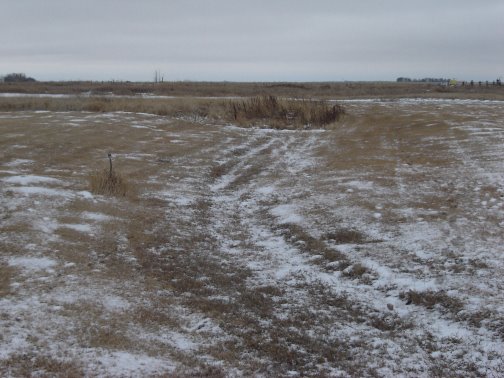
Here is the habitat where I found the seaside arrowgrass:

The tall specimen was in the unmowed part of the ditch, in the middle distance, while the short ambiguous specimen that I showed you first was in the foreground here, just in the edge of the ditch. Here's a close-up:
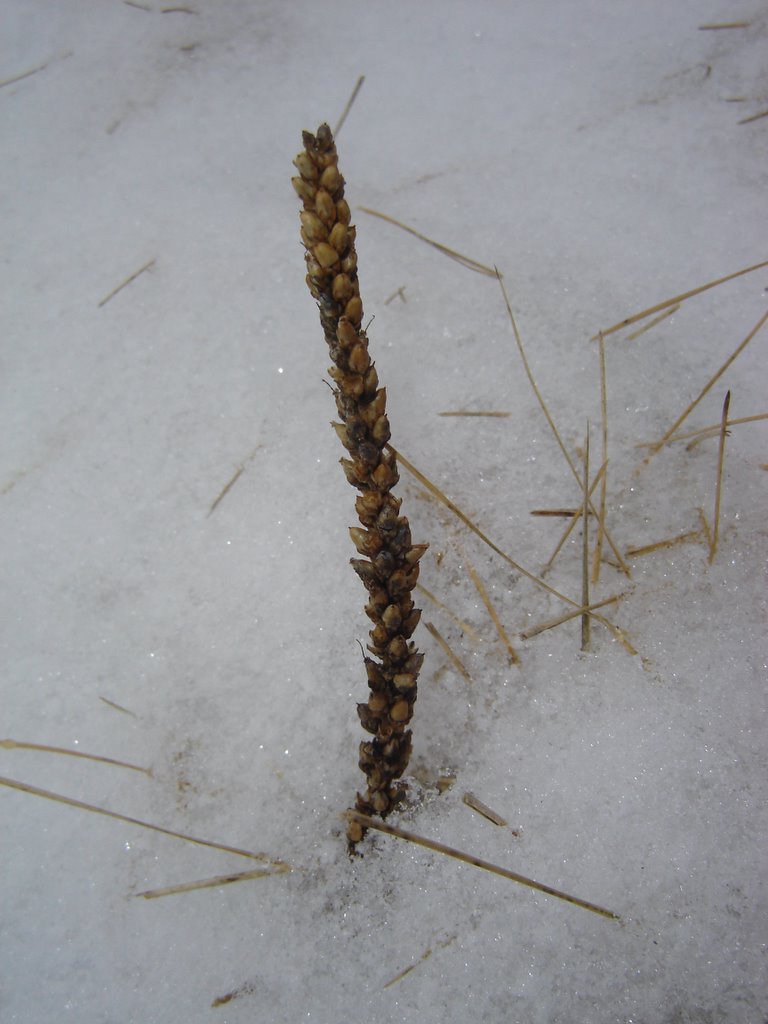
Unfortunately these photos make it look like there is one ovoid seed on each little stalk, but actually what you see is a cluster of six long thin seeds on each little stalk. (A monocot characteristic, generally: flower parts, and seeds or rows thereof, are in multiples of three). And here are some more photos of common plantain, this time from the edge of my driveway, barely 100 metres away from the saline ditch shown above.
Here what you see are rounded capsules attached directly in the spike without little stalks, and each capsule contains a few tiny seeds.
So there you have it: probably far more than you will ever need to know about distinguishing seaside arrowgrass from common plantain in winter.
I had great fun doing this. I know I promised grasses today, but I will leave them for . . . the day after tomorrow. You see, I got a gorgeous photo today, and I can't wait to share it. So tomorrow's topic will be a couple of sticky plants. Then some grasses!
Wednesday, January 11, 2006
Winter Botany #1
It was a dull, grey day, not at all like those ideal days that I've missed, but I took pictures anyway. Almost fifty of them. Today I'll start with a few fun and easy plants. Tomorrow the grasses!

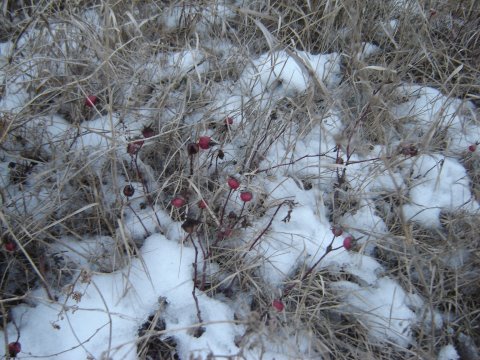
Rosehips can catch the eye, even if you're not looking for plants at all. These very low-growing roses (only about 10 to 15 cm tall) are probably Rosa arkansana, or prairie rose. They are persistent little plants, showing up in old seeded pastures and clinging along roadsides "between the grass and the grader blade," where they sometimes make a bright border of white-to-pink blossoms that almost hide the tiny shrubs beneath. I say "probably" prairie rose, because I didn't actually check for any identifying characters, just assumed on the basis of size and location. We have a couple of other rose species here, but they are usually larger shrubs, not found scattered in open grassland but rather in shrubby patches or as understory in woodlands.
Plantain, and probably not one of the native species. If I wanted to be sure which one, I would dig away the snow and look for leaf remains. Since it was growing on the edge of a dirt track in the old "brick ponds" area, I would expect to find large, oval-shaped leaves telling me it's Plantago major, common plantain, also known as "Whiteman's-foot" because it came into the area with Europeans and seemed to appear wherever they went.
There is another plantain with fairly broad leaves in the area, Plantago eriopoda, but its leaves are quite a bit narrower than common plantain leaves, and it has some wonderful brown wool in the crown (the base of the plant where all the stems and leaf bases arise - hidden in the snow). P. eriopoda also tends to favour saline soils, instead of showing up all over.
I was going to give you one more, but the kids are home. Check back tomorrow - hopefully I will have time to start to tell you how I know these plants.
Monday, January 09, 2006
Left-hearted
I was conscious of a sprinkling of political philosophy throughout the book, foreshadowed by the dear troll's membership in the LEFT Association (but LEFT stands for Leprechauns, Elves, Fairies, and Trolls). However, the philosophy was almost as eclectic as the setting, characters, props, and story elements, and for me it was all good fun.
Sometime afterward, I found myself thinking: "It's okay to be a little left-hearted, as long as you're right in the head."
******
p.s. If that's got you trying to remember a quote about having the heart to be a liberal when young, or the brain to be a conservative when older, you might be interested in what the Churchill Centre has to say about that quote.
Saturday, January 07, 2006
One less weird thing about me:
I had fun watching, anyway. I never watch pro hockey, so I'm easily impressed by a bit of stick handling or a quick turn. I'm happy if I can keep track of where the puck is most of the time. Next I'll start trying to figure out offsides and icing. Hmm, sounds like I'll be going again. I didn't much like it when it got mean, except for the fascination of seeing a guy skating toward the penalty box and laughing merrily with the ref. I might learn something about human nature.
Next home game is Tuesday, January 17th against Bienfait. I know, that name looks like "well done," but the way we pronounce it around here, we're talking about the destiny of beans.
To link or not to link
No problem, and thank you. If I've seemed ambivalent about people pointing links at my blog, it's not that I think they should ask permission. If I publish something here, then pointing a link at it is just like recommending a book, as far as I'm concerned.
The only reason I hesitate, is that I originally intended this blog to serve a more local audience. I haven't done much to promote that (such as posting notices of local events, or seeking out local stories, or advertising the blog locally), and the 'Gist has certainly drifted as I have found myself involved in other communities - blogging communities. When I am writing a post, I'm thinking about my audience, and from the comments I get, I'm guessing that many of my readers are fellow bloggers from all across the continent. Sometimes I wonder, though, whether it's just that they speak up, and people close to home don't.
Maybe I should get a site meter, but I'm afraid to, because I might spend too much time checking it!
So tell me, do you want more local content?
Should I keep my blog's sidebar more or less as it is (a glimpse into my own reading habits, plus an assortment of links that I judge to be of local interest)? Or should I add the Sask Blogs blogroll, and possibly other blogrolls? Personally, I tend to ignore blogrolls. I find the links that are hand picked by a blogger more interesting. Actually the top two ways that I find new blogs to read are:
2) adding items to the "Interests" and "Favourites" sections of my Blogger Profile (anyone can get one), and then clicking on them to find other bloggers with common interests; and
1) noticing new commenters at other blogs. If you browse the comments over at maison madcap, you can see the influence that Madcap's community has had on my sidebar.
******
p.s. If you're a blogger who has linked my site in your sidebar, and you're wondering why I haven't linked yours, don't take it personally. It may be just that I haven't got to it. I'm stalling about updating my links list, because I want to do some thinking about my selection criteria. Hence this post. Comments welcome!
Friday, January 06, 2006
Privacy and community
However, I recall an incident a while ago, where a whole shipment of United Church Observer magazines got sent back to the publisher rather than put in the mailboxes, because the labels had only names and not box numbers. This was not a new situation, just a new postmistress. The subscriptions were paid by the church on behalf of its members, and the church had never asked its members to supply their box numbers. It hadn't been necessary. So, there was a big campaign to find out each member's box number and get it added to the subscription information.
All that aside, I got thinking about published directories, and privacy, and community. It crossed my mind that we could make a community directory of P.O. box numbers, with listings voluntary. But then I thought--no. For the small convenience, it would not be worth the exposure to ad mail. More importantly, I thought, even the small convenience may have a cost, in the long run. These days, it is possible to insulate yourself from a great deal of personal contact by getting your information through the printed word. If you can find all the information you need in a handy booklet, or here on the Internet, you may not go ask your mother or your neighbour or that friend of a friend who would surely know. Each time that you don't ask, there's a little thread of connection that doesn't get made, and your community is weaker for it.
Thursday, January 05, 2006
Five Weird Things
"List five weird things about yourself, then tag five others to do the same"
Wa-ell, let's see now.
1) I live in Arcola and I've never been to a Combines hockey game. (I'm not proud of this; it just is. Maybe Saturday.)
2) I've been known to walk downtown pulling a cooler on a toboggan to get my groceries. I'd be making a habit of it, but there's not enough snow yet. (My teenage daughter is probably praying that it never snows again.)
3) I still let my mom buy most of my clothes. She just watches for whichever essential item looks most worn, and replaces it.
4) I love ballroom dancing, traditional dancing, anything that gets you matching patterns to music. In my generation, that's weird. (Scroll down in the link to see the Arcola Scottish Country Dancers - can you spot me?)
5) My idea of a perfect family outing is to bike down to the creek, climb down the dusty rocks, and try to balance through the culverts without getting wet. The kids love it too, although they'd rather we drove. Sigh.

As for tagging, any fellow bloggers who feel so inclined, consider yourselves tagged (just drop a note back here for those in pursuit of weirdness).
And you non-bloggers: how about this. Click on the comments link below and get your feet wet. Tell us all five weird things about yourself. Or if you're too shy for that, just tell the world a few weird things that I neglected to mention about myself.
Monday, January 02, 2006
New Year's Eve

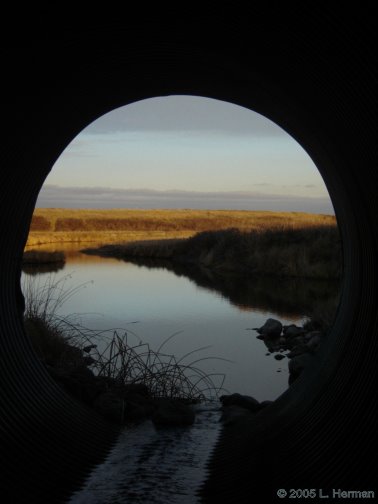
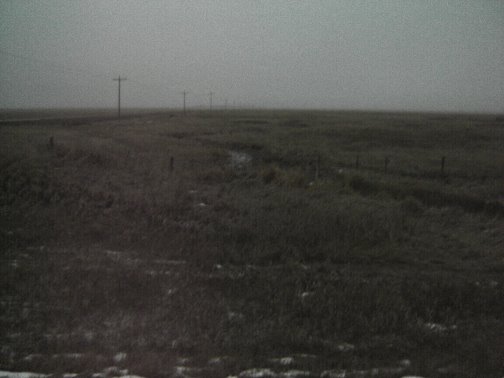
Sorry about the dim photo, but that's about the best I could do at 5 p.m. on New Year's Eve. Another unusual thing about this view (looking north from the highway just west of Arcola) is that you can't see the hills, only about 3 miles away and rising nearly 400 feet above this plain.
I spent the later part of New Year's Eve downloading the climate data for western Canada and browsing through snow-depth records for our area. I found some partial records for Handsworth and Willmar starting in 1980, but for a consistent and older record the closest station I found was Estevan, with data going back to 1955. I had been thinking these brown Christmas holidays were a new thing, but Estevan had Christmases with essentially no snow in 1957, 1966, 1976, 1979, 1986 and 1987, as well as the recent ones that I remembered from 1997 and 1999. A brown New Year's Eve is a little more unusual, but there was only 2 cm of snow on the ground in Estevan in 1956. Other years with little or no snow on New Year's Eve include 1979, 1980, 1986, 1987, 1989, 1997, and 1999.
When I compare these records with the partial data for Handsworth (in the hills west of Moose Mountain Provincial Park) and Willmar (south of Arcola), it seems to confirm my suspicion that we often have snow when Estevan doesn't, and the hills may have snow when the nearby plains don't. Handsworth had 6 cm on New Year's Eve 1986, and 7 cm in 1987. Maybe there weren't any brown Christmases at the farm when I was growing up, after all. I don't know what the snow is like over at Handsworth this year, but when I drove out to the farm yesterday, the hills were still looking very brown here.
Daily precipitation and temperature records are available for many more stations and much longer periods than the snow depth data. I wonder how hard it would be to model probable snow depth from those records, to estimate how many brown Christmases there were back in the early 1900s. It might be easier and more accurate to just ask around among the old-timers. Hopefully their memories are better than mine.
Anyway, if you're wondering how I marked the turning of the year, I didn't. It passed quietly sometime while I was exploring tables of snow depths. Garth was incommunicado in Pokhara, Nepal; otherwise it would have been fun to do a couple of phone smooches, once when midnight swept by over there, and again when it finally got around to us nearly twelve hours later.
His New Toy

That metallic object in the background is . . .
. . . the strainer from the kitchen sink.I found it here in the opposite corner of the house, so I'm guessing that it gave him some considerable amusement as he batted it along.
Nothing is safe from him now, unless it's behind a closed door. I expect we'll soon be needing latches installed on the kitchen cabinets.
It's his electrical cord fetish that's the worst, though. I'm amazed he hasn't chewed through a live one yet. I forgot and left the sustain pedal for the keyboard on the floor, and not twenty minutes later, I found the cable nearly severed. I have cords tucked into gaps under baseboards, cords shielded behind boards braced behind furnishings, cords taped up along furnishings . . .it's starting to look like a choice between him and electricity!