Showing posts with label gardening. Show all posts

Thursday, December 29, 2011

Top Ten Things You Can Do for the Environment

It's the time of year for top-ten lists.  Here's mine:

  1. Grow a garden.  Yes, you.  This has finally started to turn up on a few lists, long overdue, but it's usually way too far down the list.  Don't have a bit of land?  (Are you sure?  Think small, even a planter or a window box.)  Help a friend.  Get a community garden plot, and again, maybe go together with a friend on this.  The most important tip for a beginning gardener: start small.  It might seem insignificant, but you will be surprised at what you can produce.  And transportation of fresh produce is a big part of our ecological footprint, so a successful small beginning at gardening may have just as much impact as any other green project you could do. 
  2. Take up hunting or fishing.  Yes, you.  Yes, kill something.  Do it close to home, and you will have to learn about the natural habitats of your own area, where they are, what sustains them, and what threatens them.  They need you.
  3. Eat what you kill.
  4. Eat smaller portions of meat: a piece about the size of your palm and the thickness of your pinkie finger is plenty, even with all that vigorous gardening and hunting you will be doing.
  5. If your hunting and fishing doesn't fill your reduced meat needs, look for domestic meats that are grown locally in harmony with the natural habitats you learned about in #2.  In my area, that means range-fed beef, which uses self-guided cow-power to harvest and fertilize natural grassland instead of plowing it up and using fossil fuels to cultivate and fertilize grain crops.
  6. If, after all this new recharge time you are spending in your garden, on the trail of a deer, or on the water with your fishing rod, you still feel the need for a holiday from your life, take it close to home.  Check out nearby parks, festivals, galleries - try your local tourism agency if you need ideas.  Try something different: a bike tour, or paddling lessons; a retreat to learn about the enneagram; a music camp where you can learn to play an instrument.
  7. Buy less, but when you do buy, spend more.  Buy quality, to last a lifetime.  Help the economy shrink back so it fits within the biosphere instead of mining the Earth.
  8. When giving gifts, show your caring through the time and thought you put in, instead of the dollars.  In my family, for the last couple of years, CHRISTMAS stands for Consumeable (or Cookies), Homemade, Recycled (if you're not using it much but someone else would, why not?)... and I have been trying to extend the acronym to include Indirect (a gift to charity), and then the rest of the letters make an excuse for buying something Specific to that person and Terrifically Magically Awesomely Spectacular... such as the lightweight plastic trombone we found for my Mom to help her continue marching in parades well into her 70s.
  9. Don't have time for all this?  Do it anyway, and with the money you save, quit working.  Give up that second income, or the overtime.  Change jobs if you need to.  Take back your life.
  10. Tell your local political representatives what you are doing, and why.  Destroy their argument that we can't make changes because the public won't change.  Change, and show them.

Thursday, October 07, 2010

Parsnip - unedited


Remember "Rootabigga"? I think this root is actually bigger. Mom and Dad have a great garden on a spot where they used to feed cattle. That fertile soil combined with the non-stop rain this year produced some sensational parsnips (and carrots, and beets, and lettuce that kept producing all season instead of bolting in July).

The boy is definitely bigger. In about a year he went from shortest in the family to tallest. I don't think there was anything special about growing conditions that year; it was simply time to grow.

Monday, May 11, 2009

Cultivating Our Roots

My Mom has published a beautiful book:


She wrote it from the perspective of a retiring seed grower, which means it can give the impression of a technical manual for a very narrow audience, but don't be fooled. I say, if you live in my ecoregion, you need to see this book.

Even if you will never grow anything, you might want to get acquainted with these plants. Consider this: they're your neighbours. They were here before you were, and likely will be long after. They might all look like "just grass" to you, but once you take a closer look, you may be astounded at the diversity in a tiny patch of unbroken prairie.

But here's the tricky part. Have you ever looked at a grassland in early June or late August and tried to find pictures in a field guide to match what you are seeing on the ground? Good luck. If you or anyone you know wants to learn to recognize some of the most common grasses and wildflowers of the mixed-grass prairies in the northern plains of North America, I say: start with this book. There are excellent photographs of multiple life stages of each plant, so you stand a good chance of recognizing your leafy new friend throughout the growing season - even when it's not so leafy. You won't have to wade through pages of obscure plants that you will never see, because there are only 62 wildflowers and 22 grasses included - only the most common species plus a few uniquely interesting species like buffalograss (rare in our region but common farther south in the short-grass prairie). As you learn the plants, you can also learn to recognize similarities among species in the same plant family, since the book is organized by families and includes identifying characteristics for each. That way, when you meet a plant that isn't introduced in the book, you may well be able to say, "You look familiar - aren't you related to..." and all of a sudden you will have a nodding acquaintance with hundreds of species.

And of course, if you want to actually grow these plants, whether as a seed business or just as a minimal-input alternative to a thirsty hungry lawn, you could benefit from the tips on planning and preparing a site, the illustrations to show you how your plants will look (even as seedlings so you can tell what not to weed out of your plot), the germination information, and tips and pictures to help you collect your own seed to get started.

I used to do inventories of the plant life on proposed oil and gas well sites. I worked with numerous floras and field guides, and through struggle and persistence, reached a point where I can look at most common prairie plants and just know them, no matter how small or shrivelled. But when I first started, and even in recent years when I was working very early in the growing season, I wish I had had this book.

Oh and did I mention that it's beautiful? People here were buying copies as Mother's Day gifts, just for the pictures of the their mothers' favourite flowers.

Yes, I'm proud of my Mom.

Tuesday, October 28, 2008

Annie Gardenbed's Song

Your world is good for me
and so I give you thanks
for soil and seasons, seeds and sun,
for water and wisdom and work to be done.
Your world is good for me
(Annie Gardenbed) -
Amen!


Sorry about the Noncommercial break, but I wanted Disney's
legal hordes to know that I'm not trying to profit by this.


Your world.
I don't say who "you" is, but there is no need. I am singing to one who is present, listening; why use a name? It would only drag us off into arguments about the connotations of the name, and then about which gender of pronoun we should use when the name is too burdensome to speak in its entirety.

Isn't it rude to argue about someone when they are present?

Your world is good for me.
It is a whole world, and it is larger than my doubts and fears about what may be done to me specifically. It is a good place in which to choose my way.

I give you thanks . . .
and in so doing, I open my own eyes, and my whole being, to the wonder, blessings, and possibilities that are all around me, always, whether I remember to give thanks or not.

Soil.
Do I own it? Because I can surround it with survey stakes, do I really own the soil? If I turn and tear it with the movement of steel, driven by combustion commanded by cash, do I forget? It is much more ancient than I and my title. It is more fluid and changing than the lines on the deed. It anchors the roots of life, records the traces of centuries, and yet whole decades of its building can be swept away, to a new place and people, in a few windstorms or a single flood.

Is soil, all too often, taken as a given instead of as a gift?

Seasons.
Dave Sauchyn of Regina, trying to create the few bullet points asked of him to somehow sum up a 448-page report on the impacts of climate change in Canada, said this:
Canada is losing the competitive advantage of a cold winter.

Seeds, sun, and water . . .
the things we often remember in our thanks.

There is so much more.

Wisdom.
If you find a little here, I am thankful.

Work to be done!
In our modern world we only deem something a success if we can stand back idle and watch it work. If any physical effort is required, it is an outright failure. . . . The very first thing we do when seeing something so elegantly simple and useful as this pump is scheme to make it work while we just stand by and stare at it.

There is a pitfall in being thankful for things given to us. The story of Johnny Appleseed is inspiring, but the popular version, as summed up in the merry little verse, drifts toward a "big-rock-candy-mountain" vision of idyllic idleness achieved at last, as a result of someone else's generous hard work. That vision entices, seduces, and robs us of the wonderful gifts of our own work: tending; bringing forth; growing strong; growing wise; being present; finding meaning.

Through work we receive the ability to give.

Your world is good for me!

Amen.

Wednesday, October 22, 2008

Annie Gardenbed

I aspire to be known as Annie Gardenbed someday - but I aspire to be and do many things, and I can work on only a few at a time, so if someone else earns the name first, I won't be disappointed. I hope this blog post might help that happen.

Why Annie Gardenbed? Well, it's a little play on the name Johnny Appleseed. I'd like to be like Johnny, except that instead of planting apples, I'd be digging new garden plots and getting new gardeners started.

The popular legend is that Johnny wandered all over planting apple seeds almost anywhere, so that whoever came along later could gather apples. As with any legend, the reality is similar but different: John Chapman was a wandering planter of apples, but he planted nurseries in areas where settlers would soon be arriving, and had the seedlings ready to sell to the settlers for their homestead orchards. Still, the legend captures some of the spirit of his life and legacy, in that he lived extremely simply; he was generous in his dealings; and his undertaking was remarkable enough to earn him the nickname "Johnny Appleseed" by about halfway through his long life. The real story, or what we think we know of it, is richer and stranger than the legend, and definitely worth a look.

When I came up with the idea of "Annie Gardenbed," I knew only the popular legend of Johnny, and a related little song that we often use as a mealtime grace:
Oh, the Lord is good to me,
and so I thank the Lord
for giving me the things I need:
the sun and the rain and the apple seed.
The Lord is good to me.
Alleluia, Amen!
Many people sing "Johnny Appleseed" instead of Alleluia in the last line. The song appears in many places unattributed, as if it were a folk tune going back to the days of Johnny himself, but thanks to Cathy's Grace Notes, and some further sleuthing, I learned that it is a verse from a song written by Kim Gannon and Walter Kent for the Walt Disney Music Company in 1946, and sung by Dennis Day in the animated short "Johnny Appleseed" (part of Disney's 1948 release "Melody Time"). The sheet music is still available.

I'm disappointed. Today while washing dishes I came up with a little verse for Annie Gardenbed, but I don't dare tell you what the tune is, or Disney might come after me. I'm not afraid of ordinary mice, but . . .

I think I'll see about a public domain license for my verse, before I post it. That way at least I'll have evidence that I'm not trying to profit from Disney's tune in any way.

Or should I just go ahead an post it anyway?

Saturday, October 11, 2008

Harvest Home

Picture this (because I don't know where to find a camera with batteries charged up):
  • onions and beets spread to dry on newsprint
  • cardboard boxes brimming with carrots, potatoes, and squashes
  • bags of dry beans, with the sides rolled down to let the beans dry a little more
This week I'll be storing things away a little better: tucking the onions into old nylons and hanging them on nails on the floor joists in the basement; cleaning up some of the carrots and beets and finding some room for them in the fridge, freezing some others, and maybe drying some for soups, too; and clearing some room in a not-too-cool spot for the squashes to sit with some air spaces between them. The dry beans are experiments. I have been growing Windsor broad (or fava) beans for several years, but never understood what they should look like when mature. Finally I read somewhere that they can be picked when the pods start to turn black, and realized that this was not a sign of disease! I let them dry on the vines, and today we gathered them. Also, as a sort of accidental experiment, we gathered the dry wax beans that we didn't get eaten as fresh beans in the summer. We eat a lot of kidney beans and some chickpeas, lentils, and pinto beans, but all of these are tricky to grow in our short summers, so I want to experiment with some other dry legumes. We'll see!

I am very tired, and very happy. I let myself be led away from the garden path for most of the summer and early fall, and when I heard the word "snow" in the forecast I feared I had left it too long, but the rain and snow held off and we got it all in.

Happy thanksgiving!

Friday, June 22, 2007

Illich and My Garden

I found an archive of writing by Ivan Illich. I love his analysis of the number of hours put into owning and operating a car in a year, and the mileage gotten out of it. Divide the miles by the hours and you get about five miles per hour. Might as well walk!

This summer I have been resorting to a lot of powered and packaged conveniences in hopes of completing a renovation project quickly, before winter comes swirling in through the gaping hole that will soon be cut in the house wall. Ultimately that hole should let in a lot of sunlight and help keep the house warm, but only after a lot of framing and roofing and installing of windows and such. I'm in a hurry, and Dad has the tools, so I'm using them.

But I couldn't give up my garden, not even for one season. This winter I tried out the Ecological Footprint Calculator and realized that the environmental impact of food transportation is even larger than I thought. So I garden, stubbornly. There are some pictures over at my garden blog. I used to call it The Daily Bed, but now it's The Occasional Bed - still just as many beds, but less time talking.

Thursday, June 14, 2007

Sibling Friendliness: Only If You're a Plant

Experiments at McMaster University have turned up evidence that plants are more friendly toward their siblings than toward unrelated plants. Fascinating stuff, but I'm not sure I agree with the comments in the article about implications for gardening. If growing near strangers causes plants to grow more root mass, is that a bad thing? I'm thinking a little bit of competition early on (maybe eased by thinning a bit later), might make all the plants more vigorous underground, so they would be better prepared to deal with drought.

You would think, after all these weeks trying to garden in sticky mud, I would quit worrying about drought.

Nope. I'm from Saskatchewan.

Friday, May 25, 2007

Frost and Drought

I may have lost some tomato plants last night, even though I had them covered. No big problem - I knew it was a gamble, and I went ahead and set some out because I had lots of extra transplants to keep as replacements. But it got me thinking about last frost dates.

We had some very early warmth this spring. Farmers were out seeding in late April, and I would say that's about a month ahead of the traditional seeding time for this area. The ground dried out, and I got worried about drought. Then it started to rain, and I don't trust my cracked gauge, but Mom says they have had 5 inches in the hills since May 9th, while the average for the whole month is only 2. But before all that happened, at the end of April, I was gardening with drought in mind. I refused Garth's offer of rototilling and in fact refrained from digging the beds at all, to conserve moisture. As I started planting early vegetables, I went to fetch water from the ditch near our yard and found that it was already dry. I took my bike and trailer and hauled a tub of water from a vernal pool over on the east side of the 604. I was worried, but full of hopes that my earliest-ever garden planting might help get plants well established before a summer drought hit hard.

Last year I talked to many people in this area who said the crops turned out better than they expected, considering how dry it was in the latter part of the summer. One farmer friend agreed with my speculation that the early spring and early planting had allowed the crops to get a better root system established, so they weathered the drought better than in former years.

But as my tomatoes show, early planting is a gamble. I don't know much about frost tolerance of the common field crops in this area, but I know there are times when fields have to be reseeded because an early crop was killed by frost. As our springs get warmer, and droughts become more frequent (as predicted due to climate change), farmers may try to adapt by planting earlier. But what about frost? How are the last frost dates changing?

I pulled out my CD of climate data for Western Canada and checked what was available for our area. Carlyle had max/min temperature data from 1922 to 1996 (with one year missing, 1962). I plotted last spring dates with temperatures less than or equal to 0ÂșC.

Now, where is my old statistics text book? I vaguely remember a lot of cautions about interpretation and testing where time series are concerned, but to me this graph seems to confirm my suspicion that last spring frost dates have not simply moved earlier. They have become more variable, with earlier dates contributing almost all the new variation, but late dates still occurring frequently.

What does that mean for adaptation? In my garden, I can plant things in succession, I can hold back extra transplants as replacements, and so on. But in a farm operation with thousands of acres under cultivation, what is to be done? Can farmers absorb the costs of having to reseed fields one year in six, say, or one year in four? Can they choose their planting dates strategically and be prepared for reseeding operations, or do they have to get it all in as quickly as possible and get back to their off-farm jobs? I wonder.

I also wonder about spring weather patterns in terms of soil temperatures and growing degree days and the overall shape of the warming. My second planting of peas has not appeared yet, and I think it's been ten days. Did the recent cold and cloudy spell chill the soil and rot the seed? How does this spring compare to the springs we used to get? Was a steady warming more the norm? I will have to ponder how to analyse my climate data for that.

UPDATE: Oh, yeah, and speaking of adaptation, I forgot to mention that whole area of adaptation that most people never think about, where there will definitely be problems: adaptation by every other species except human beings and their little collection of manipulated plants and animals. Are we already seeing the effects? What about that die-off of poplar in the hills in the '80s? The experts blame insects, but the locals say it was a combination of drought stress and a late frost. What about the decline in bees across North America? Insects can adapt fairly quickly because of their short generation time, but pollinators are closely co-evolved with plants, and some plants take a long time to reproduce. These changes are happening incredibly rapidly when compared to previous evolutionary history. Can genetic adaptation keep up?

Thursday, May 10, 2007

Real Gardening

There's a fine new reality-check blog post about gardening over at the Free Man's Garden. If you haven't met Eleutheros yet, oh, you should. Check out his advice on eating, too, at the Free Man's Table, and if you get to wondering how far removed he is from the dominant society, the archives of his original blog will tell you just How Many Miles from Babylon. A few hours at his place might shake you up. They might give you some real hope, too: not a vague hope for greater equity and unity and efficiency and all that, but a clear path to actually reverse your own share of the worrisome world trends. No more hand-wringing, friends; let's roll!

**********

Yes, I'll admit I'm a fan. And I'll admit that I've been spending too much money on garden gadgets and supplies. And as I ate my packaged breakfast cereal this morning, I thought about how I've backslid from eating mostly bulk-purchased whole foods. Right now, though, my focus is getting the garden in so we don't backslide too much in that endeavour. Next comes the renovation for a greenhouse area and passive solar heat - a step forward. "When the work's all done this fall," as they say, there will be time for more conscious cooking and eating.

One small triumph: today I am slow-cooking the last buttercup squash of our crop from last year. All I did with the squashes was to bring them into the porch, which gradually cooled through the fall to about 5-10 degrees C. All winter they decorated the steps in there, and most of them kept beautifully. And now we will be losing the porch to make way for our sunroom. I hope the new cold room that we tucked into the design will work as well.

Monday, March 05, 2007

Garden Planning and Unconscious Competence

My uncle out in B.C. moved from his acreage to a care home over a year ago, but he still got this season's Lindenberg seed catalogue in the mail. Mom and Dad were out to visit him this winter, and brought the catalogue home as an extra for me. It sat out in the living room for a few days, and then moved into one of my stacks where it was in danger of lurking until sometime after the growing season. Noticing this hazard, I fished it out, and while pondering where to put it for timely attention, I started leafing through it. A pencil came to hand, and I put marks by the vegetable varieties that looked good at first glance - mostly the same ones I recalled using last year, and a couple of the new ones, and one or two daring different things.

Then I balanced the catalogue on top of a stack of unfiled band music, partly under a leather wrist strap designed to hold a flutists' music lyre for marching, all of which rested on an assortment of clarinets (in disassembled form inside their cases, of course).

I had a reason. All this stuff was on the kitchen floor, mostly in the way of our usual path of travel through the kitchen, waiting to be delivered or handed to my parents for return to their collection of band instruments and music out at the farm. It was right there in plain view, and when I walked past it, seeing the catalogue there would remind me to carry on out to the shed and look at my leftover seed packets from last year to confirm my choices and choose my quantities. If my parents showed up, I would do all that in a great rush and hand them the seed order to send in with theirs. All very logical, you see.

Perhaps something else got balanced on top of that stack.

Perhaps the bright green of the catalogue cover became part of my normal expectation of the view in the kitchen.

At any rate, I must have stepped around that stack of stuff many times over the next little while. I remember having a nagging feeling that I should do something about it before it became a major irritant to my spouse.

Then one day the whole stack was gone. I was vaguely uneasy, but mostly just grateful that responsible parties had sent it on its way. I dashed through the pleasantly clear kitchen space on my way to somewhere else, and that was that.

Last weekend I was in Estevan for a Presbytery meeting, and getting a new muffler and tailpipe installed while I was there. Once the truck sounded like her old self again, I spent the remaining time before the meeting drifting through some big-box stores in search of items that my children desperately and very specifically desired. Neither of these items was anywhere to be found, not even in the brand-new 110,000-square-foot Wal-Mart. I know the square footage because the city manager addressed our meeting and proudly described this new store, fully double the size of its previous incarnation in the mall just up the street. He suggested several times during his talk that we could do some shopping while in Estevan. After he left, there was some discussion about changes to the agenda due to the cancellation of an evening presentation, and someone called out that we could have a video presentation instead: "Wal-Mart: The High Cost of Low Prices." I confessed to someone that I had been to Wal-Mart that morning - and had come out empty handed. I'd also been to Canadian Tire (where it is now a challenge to find the tire section way back behind all the household, hardware, and recreational departments), and there, as I wandered the aisles fruitlessly, I paused to peruse a rack of "Heritage" brand garden seeds. I was surprised to discover that the company was headquartered just over in Brandon, Manitoba, the same place as our trusted Lindenberg. The varieties were familiar standards; many were my own favourites. It occurred to me that I really should get at the garden planning and seed ordering. I was tempted to just gather up an assortment of seeds right then and there, but the prices looked a little high, and I decided that if I was going to just buy off a rack, I'd prefer the rack in our own local grocery store.

What with the meeting Friday and Saturday, and potluck lunch at church on Sunday, and a little talk to give there about my idea for a Lenten fundraiser, the weekend didn't give me much time to regroup. Weekdays used to be my quiet time for taking my own directions, but not so now, with James being homeschooled. Sometime during the scramble of the following week, the phone rang, and Mom said she wanted to confirm some details about my seed order.

I was baffled.

I stammered something, and she insisted that she had a seed order from me. It was in that green catalogue from Uncle Frank.

Well, bless you, Mom. She had found my little pencil scratches scattered through the margins of the vegetable section, decided on quantities, chosen for me where I had put a question mark, and made up the order.

I guess I've done my garden planning for this year.

Friday, October 13, 2006

Rootabigga

I think it had something to do with rainwater running down the path and puddling against the floating row cover, next to this root. Most of the others look more like purple-topped parsnips.

Wednesday, August 02, 2006

Early Tomatoes


Wow - I grew these! (With thanks to Mary Milligan for the excellent tomato plants from her greenhouse.) Picked yesterday, August 1st. Delicious.

Wednesday, June 28, 2006

Wrigglers in the Rain Barrel

I was filling up my cordless hose* by dipping it in the as-yet lidless rain barrel, when I noticed the wrigglers. I'd been watching for them. Time to water the whole garden, instead of just the new seedlings, and empty the barrel.

As I got down to the last few inches of water, I noticed some red flakes swirling on the bottom of the barrel. It took me a moment to realized that these were bits of paint from the 50-year-old wooden shingles above. I don't know how old the paint is, but I'm hoping it's not old enough to have a lot of lead in it. I'm sure the roof has been shedding paint for many years, but lately it's been shedding shingles too; just single narrow ones so far, but enough to get me thinking renovations again.

Back and forth I go with the watering can, and round and round go my thoughts. Are we staying here? Moving to a farm? If we're moving, do we try to leave this place a little better than we found it? Or just fix the worst things and get on with our own lives?

And here I am with the first garden I've ever cherished. Must I give it up already?

***

*cordless hose: a watering can - much more convenient than being tethered to a faucet

Monday, June 26, 2006

Kids in the Labyrinth

Sorry, no picture.

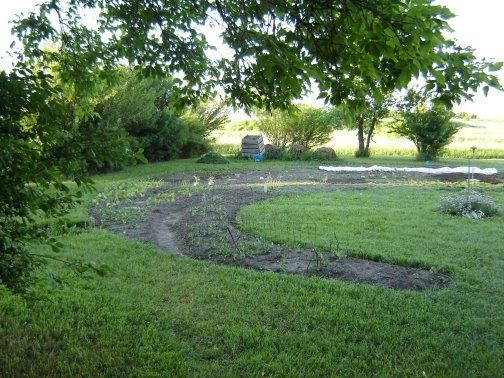
James's class from school came to see the yin-yang garden today. They all tramped through in single file behind me, and several of the boys seemed to think it was cool. Then they continued on their tour with Arcola's area historian, Adrian Paton. They paused at the end of the yard and I listened in while he told them about the brick ponds. Apparently there were drying sheds just south of our place, and kilns beyond that, close by the tracks so the finished bricks could be loaded onto rail cars. I wonder how far they went.

I may have mentioned this before, but if you know of some old Arcola bricks that could be had, fairly close to here, please let me know. I only need about a thousand . . .

Sunday, June 25, 2006

Tai Chi Labyrinth Update #2

If you're following the development of my Tai Chi Labyrinth garden, you might want to check my latest post at the Daily Bed.

Contrary Goddess has dubbed it a "yin yang garden," and I'm thinking that's a much more comfortable name for it. Thanks, CG.

Thursday, June 22, 2006

James has been admiring and praising my garden. Just wandering through to chat with me about something, and then he drifts off with a comment or two about how cool it is, or how it's the best garden in Arcola. Here I stifle something between a giggle and a snort. I know of a few gardens he must not have seen yet.

Still, praise from my kids is heady stuff.

Today he declared that he liked the carrots best, because they're so perfect, or orderly, or something like that. They're like a field, he said, and the onions are like shelterbelts.

It took me a moment to come up with a response that wouldn't knock his enthusiasm. I don't remember how I said it - something about tidiness not necessarily making it the best garden.

He assured me that the plants would like it. "They like a clean and tidy home."

I thought about a garden that would suggest otherwise, but he was wandering away, so I left it at that.

Thursday, June 15, 2006

The Daily Bed

This is an invitation to visit my new blog, The Daily Bed.

I can hear you giggling.

Go on, check it out. It's family friendly. Jim, you've been waiting for the garden pictures - you'll find them there. You might want to start with the introductory post.

Walk with me down the garden path . . .

Sunday, June 11, 2006

Mostly Vegetative


I am a
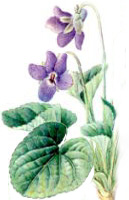
Violet


What Flower
Are You?


You have a shy personality. You tend to hesitate before trying new things or meeting new people. But once people get to know you, you open up and show the world what you are really all about.


It's a long time since I posted. I had lots of ideas, but they all stirred up insecurities about who I am and what my life is about. It doesn't help that I had a big argument with Garth, in which he rather sensationally declared that my attitude had nearly torn our family apart. (He took that back, sort of). It doesn't help that I've been making arrangements to finalize the work of my discernment committee, after an interruption in the discernment process allowed me to discern that my call had nothing to do with formalized ministry. (For now at least. Unless I discerned that all wrong.) It doesn't help that most of my significant recent activities run counter to most of what we've been talking about here and on my favourite blogs. (Taking Ruth to band camp and both kids to Mosaic, for example: a lot of pageantry masquerading as culture, and a binge of driving.)

It also doesn't help that a cold has drained me of most of my energy, and the garden is greening up between the lovely little planted things, and even though the blessed rain is keeping me out of the garden most of the time, I am trying to make things better in a vague non-reasoned way by staying away from the computer.

Well, now, I think I'll get ready and walk to church in the rain, and see if I can get in on a carpool to "Women's Day at Camp" tomorrow.

Friday, May 26, 2006

The Change at Twilight

I have to bake pies for an auction sale tomorrow. I've never baked a pie in my life. I called my Mom and arranged to borrow her pastry blender and use some of her frozen cherries. I said I'd drive out to the farm and pick them up. Then I delayed, and delayed, and she came to town and brought them to me. Still I stalled.

I showed up late for community band, and they had already written me off, assuming that I was baking. But I just figured I'll bake the pies in the morning, since I have to get up early anyway, to get Ruth on her way with the Cadets to Virden for gliding and an air show. Maybe my next post will be titled "I can bake a cherry pie!", and include a lovely picture. We can hope.

I got home from band, carried my instruments inside, and then walked back out into the deep twilight to put my bike and trailer away. My mind was churning with fruitless worry about what time I must get up, whether anyone was planning to give Ruth a ride to the air show, whether I should just buy some pies, whether I could count on finding pies for sale in the morning. As I paused outside the shed to unhitch the bike trailer, my eyes were drawn to the garden beyond. In the dim light, the image of the yin-yang leapt out at me, uncluttered by the ghost of the old garden that shows up in daylight as patches of browner sod and still-grassy tilled soil. My eyes followed the S-shape through the middle and then leapt out to the even dimmer land beyond.

In the brick ponds, a few late chorus frogs were singing yet - unable to admit defeat, I guess. All around the ponds, over that expanse of rough ground and long grass, fireflies flickered and floated like truly twinkling stars.