Showing posts with label the farm. Show all posts

Thursday, October 19, 2006

Nettle Harvest


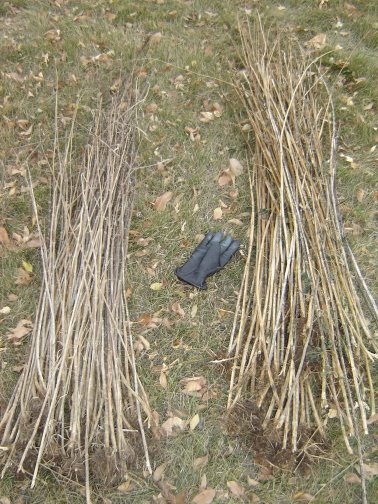
Yesterday morning I was out to the hills to help my dad along with his new musical ventures: learning to play the C melody saxophone, and doing more with the guitar. After loading him up with things to practice, I strolled out to their garden and pulled a bunch of nettle stalks from the side of the weed heap. I tried breaking one underfoot and cracking apart the pith walls to see if I could find the rumoured fibers for spinning into nettle thread or yarn or whatever it would be called, but I didn't have much success. Now I am hunting more references to glean whatever tricks I can. Perhaps the stalks will need to be retted, but I'm told the odor of that process is not acceptable indoors, and water outdoors is frozen over now. I may be storing my nettle bundles until spring.

Nettles are very noticeable, and that may explain why I used to think of them as abundant. Once I set out to gather them, I decided they're not so common after all. I know of specific places where they grow thickly, but they're not the sort of plant that you see dotted here and there through a wide variety of habitat. Now I'm thinking again that I should plant some here in the yard. (That would really raise some eyebrows, no?)

Aside from their fiber content, nettles are useful as a highly nutritious early spring green. Just boil or steam them a little to neutralize the sting.

Less directly, but perhaps more importantly, nettles have value to us humans as a food plant for butterflies. Today I found a new report on the Status of Pollinators in North America, which outlines another of those slow emergencies that will probably not get much notice until it's too late. Perhaps it will never get much notice, and future schoolchildren will marvel at the fantastic stories of a time when gardens didn't need hand pollination, and the world was home to six billion people, and candy bars were made with real chocolate (pdf).

Now for the obligatory cheerful closing note about things you can do to help. The Pollinator Partnership, at www.pollinator.org, has a long list of online resources, with everything from research about native bees, to pollinator-friendly practices for golf courses, and of course articles about gardening for bees, butterflies, and hummingbirds.

Friday, September 01, 2006

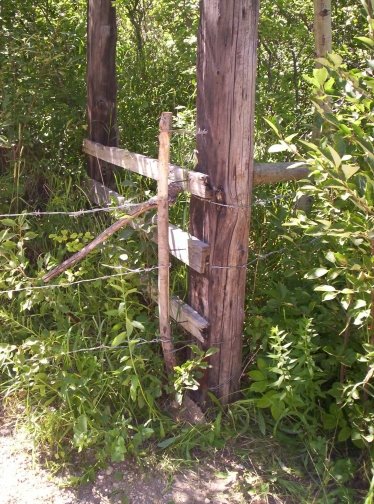
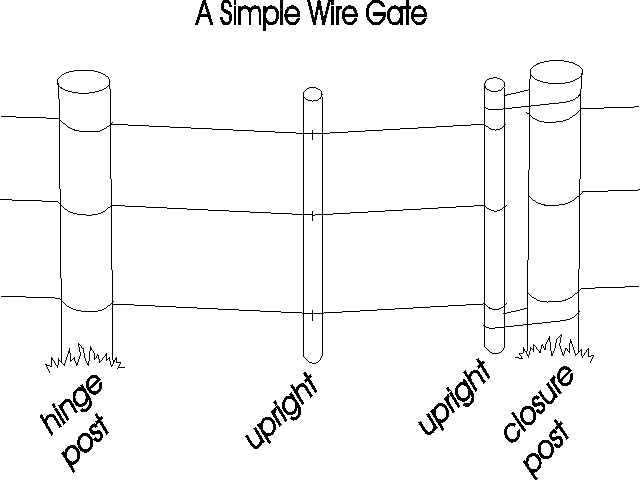
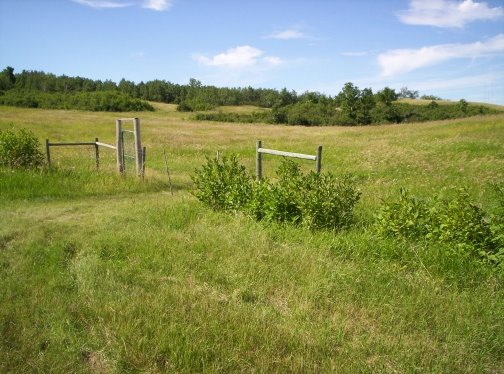
The Gate Post

. . . or, How to Open and Close a Wire Gate.

The closing part is the most important. Never open a gate that's meant to stay closed, unless you're sure you'll be able to close it again. It's like knowing how to stop a car before you try starting it.

Some people say "Always close gates," but I say, always leave gates the way you found them. Even if you come upon a gate lying open, and you can see the cattle coming, don't be too sure there aren't some herders behind those cattle, who would be more than a little annoyed if they finally got the herd up to the opening and found that it wasn't.

On the other hand, even if you can see the whole pasture and there is no livestock in sight, don't be too sure it would be okay to leave the gate open. Just picture the above-mentioned herd moving along the roadside ditch, heading for the home farm, only to come upon your left-open gate and turn aside into the wrong pasture.

If it was open, leave it. If it was closed, close it.

Unfortunately, there are several factors that may make a gate harder to close than it was to open.

One is fatigue. If it's all you can do to slip that wire loop off the gate upright, your exhausted arms will have nothing left for working it back on.


Another factor is the tendency of wire gates to tangle themselves up the moment their tension is released. Then when you try to close the gate, it can seem suddenly several inches shorter than the opening it formerly filled, due to wires being hooked on their neighbours' barbs, uprights being angled out of position, and so on. I have a habit of keeping a firm hold on that gate post as the loop comes off, and then, as I swing the gate open, walking with an outward lean and hanging my weight against the pull of the gate, much like a dog straining at a leash. This keeps the gate straight and upright with no risk of tangling. Of course, if I'm alone, I have to lay the gate down to move my vehicle through the opening, but this can be done carefully and neatly to minimize sagging and tangling of wires.

Once you have the gate back in position, be sure that all the uprights are standing more-or-less, well - upright. A lean to one side or the other can add a surprising amount of resistance when you are trying to pull the gate tight. I have found that I can usually jump them into position with a sharp upward jerk (or two) on the end upright.

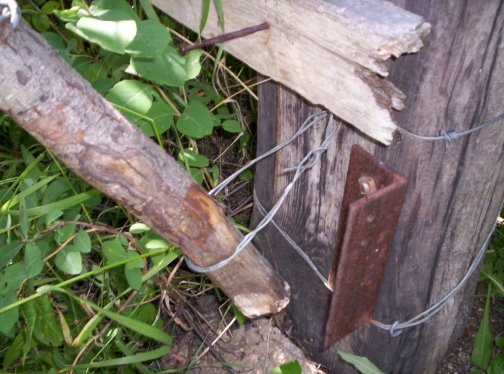
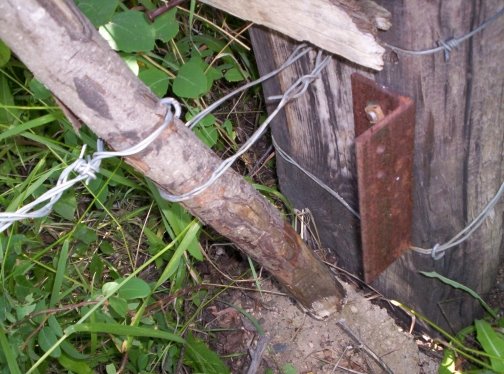
Now here's a more subtle trick to use when that top wire loop just doesn't seem to reach over the end upright: pay attention to the position of the bottom wire loop. If it's angled downward, because the upright hasn't been pushed into it all the way, then it will be pushing the upright higher, so the top wire loop has to reach higher to clear the top. The gate will also be out of alignment, so that you have to stretch it even tighter. I usually put the upright into the loop and then straighten it up some, and work that bottom wire loop upward with the toe of my boot until it's lined up well.
Bottom loop angled downward - upright (left) not in far enough

Better

If you still can't get the gate closed (and the cows are coming, and people are shouting, and oh-no-there's-the-bull!), don't worry, there's still another trick to learn. This one involves using your own body to best advantage.

Chances are, your first attempts involved pushing the upright closer to the closure post. Maybe you had one hand on the upright and one on the closure post, trying to bring those two hands closer together, and as you got more desperate, perhaps you tried to guide the wire loop with your teeth.

Try this instead.

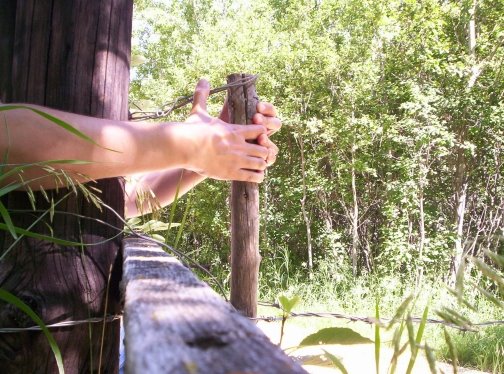
Get on the fence-ward side of the closure post, shoulder up to it, with your arms reaching around it to grasp the end upright and pull it straight towards you. Your thumbs can guide the wire loop into place without struggle or fear of pinching.

Whew! It's closed.

Apparently this stranger, struggling to open the gate, hasn't heard about that last trick. We'll just let her wear herself out and go home.

If you've been paying attention, you can easily see how some of my tricks for closing gates will also help with opening them. But I won't spell any of that out here. If somebody happened to use my advice to get a gate open, and then left it open, I might have a farmer after me with a post maul. And the more gates that are carelessly left open, the more farmers just tighten up those wire loops a little more, so that my little tricks aren't enough anymore - you also need the farmer's brawn, or another advantage which I won't mention here.

A few other notes about gates:

If you find a gate that is closed with a length of rope or chain wrapped around the closure post and the gate upright, be very careful to note how it is fastened before you release it, so you can get it back the same way. It can be a bit easier to manage than a wire loop, since you can get it wrapped loosely and then pull to cinch it up, but you may not get it quite as tight as it was to start with.

If you want to make a wire gate easier to close, consider a strap-steel lever device, like the one shown here (pdf).

While I was looking for illustrations, I found an interesting article about different kinds of gates. I like the looks of the hinged wire gate, with the rigid diagonal, that uses the weight of the gate to pull the wires tight. And the one-way wildlife gate, that lets trapped deer escape from an orchard.

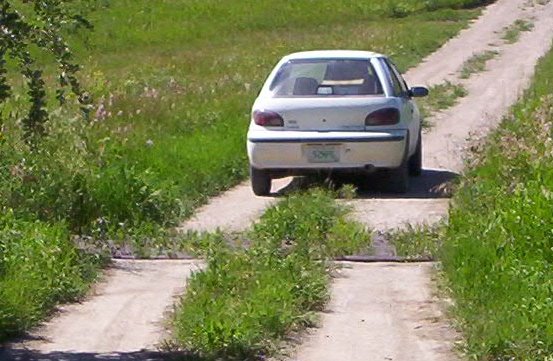
Of course, the easiest kind of gate (if you're driving something with four wheels) is the cattle guard. A steel frame supports a series of pipes across the road, level with the road surface, so that there are gaps between the pipes, and an empty space underneath. Vehicle wheels easily span the gaps, but cattle hooves are too small, and cows don't usually dare to try to balance on the pipes. We used to play on this gate while we waited for the school bus, balancing on one pipe at a time, or bracing a boot sole across from one pipe to the next. I've seen Garth ride his bike straight across it, but I never quite found the nerve for that. It's not the best picture, but you can see the plants poking up between the rusty pipes. There are better pictures in that article I mentioned above.

Thursday, August 10, 2006

Change

"How are the hazelnuts?" I asked.

"Terrible," was the reply. Mom and Dad figured that, with so little berry and seed production generally this year, anything that did grow had been snapped up.

We were chatting over lunch. I had spent the morning helping Mom in her seed gardens, in exchange for her listening ear, while James helped Dad lay some laminate flooring, in exchange for some spending money. Through the early afternoon, I played Dad's guitar with half my attention, and chewed over my favourite dilemmas some more with Mom. When the temperature outside was peaking, I decided I really needed to spend some time just walking the land. In hindsight, I think Mom probably needed some time to shake herself free of my burdensome talk.

As I climbed the trail behind the house, I thought of the camera I didn't bring. Just as well, I told myself. This time is for me, not for the blog.

I went first to the summit of Anemometer Hill, perhaps the highest point of our little highland, which is itself the highest land within the surrounding several miles of hills. I stood a few minutes just soaking up the vista to the west. And I heard myself discussing that view with blog readers, debating the definition of a hill.

The landscape is very striking these days, with the grass on the ridges dry and bleached pale, while the aspen and shrub areas are still a rich dark green. There was no water visible in all those miles of view, but I knew where I would find it.

I moved on, away from the usual routes along mowed trails, and into the bush. The cattle-and-deer trails have shifted a little since the days when I did a lot of roaming, and I spent some time weaving from one hint of a trail to another before I found the main thread of the path I remembered, and emerged onto the tiny grass area that faces northwest just off the crest of the same height of land.

I was surprised to see a large patch of blue on the neighbour's pasture to the north. That slough must be holding up well in spite of the recent drought. Maybe the rain on Tuesday brought the level up some.

Down the north slope I went, watching my footing and still slipping a little, pausing to gaze up and around at the birches and the forest canopy stretching away, and to wonder if I could capture the sense of this place in a picture. Ah, the blog had followed me here, too.

There were hazelnuts. Some were ripe already - I've never seen them that early. Twila and I used to pick them around the first weekend in September. As I moved down the slope, my path unravelled into fading threads in the hazelnut understory. A bit of colour off to the right caught my eye - high-bush cranberries! Turning red, here in the second week of August.

I cast about for the best offer of a trail, and then, noticing a brightness that might be an opening, I went sideways. What I found was more than an opening; it was the mowed trail along the toe of the north slope, and I'd have been on it in only a few feet more, if I had just pushed straight ahead.

I let it lead me west. At the edge of the hay field I paused to enjoy the return of the breeze and the last of the shade. Not a spectacular view at that spot. Dad had said something about the view I could get from the house site I'd mentioned to him - the latest dream site in a long series. I asked myself: do I need a good view? That's what walks are for. Too good a view, and I might just sit at home.

I took a few swallows from my too-small water bottle, and set out across the sun-burnt hayfield, moving gently in the heat. When the truck trail turned south, I continued west on a cattle trail toward the dam.

The ravine here used to be densely forested, like most ravines in these hills, but now there is not a large tree anywhere near the dam. It was the death of the trees, that dam, because it brought the beaver.

I remember how I used to analyze the landcover as I roamed, noting all the ways that previous tenants of this land had changed things. Now when I wander, I notice new changes, wrought by my own family, and sometimes even by me.

I wonder if Mom and Dad would have put that dam in, had they realized what the beaver would do. The first few years of impact were the most obvious, as that swath of forest fell. I might have thought that it would end there, after the beaver ran out of trees within a reasonable radius of the water. Yet now - how many years later? ten? fifteen? - the beaver's work goes on, mostly out of sight, unless you take the time and effort to walk the ravine downstream.

I crossed the dam, pausing to admire butterflies puddling on the damp mud, duckweed stippling the water surface, and a robust sedge that's new since my last visit, growing on the seepage areas of the downstream side. At the dry spillway I hesitated. I wanted to walk the bottom of the ravine, but I knew the beaver had wreaked havoc with the cattle trail down there, drowning it under a series of small pools created when they built one little dam after another below our big dam. From what I could see from my high vantage point, the problem hadn't resolved itself yet.

A new option beckoned, though: beyond the spillway, the cattle trail continued up and across the north bank of the ravine. I followed.

It was a good trail, much better than I remembered from the last time I wandered here, and taking an unusual course across the midslope. Cattle tend to drift to the bottom of slopes like this. Midslope trails do exist, winding (like this one) along where the bush ends and the grass of the upper slope begins, but on a steep sidehill, they are rarely so well travelled. I suspected that this was an effect of the beaver's work below.

Finally the trail plunged down into the thick forest, down, down, driving my toes painfully into the fronts of my boots. When the ground flattened out, the understory opened suddenly into a magical grassy place overarched with great old trees. The confluence, I realized - the place where the dammed ravine joins the Deep Ravine. This deep ravine was a dark, mysterious barrier to much of my childhood wanderings, and it poses such a restriction to westward movement that it forms a sort of boundary of our farm, though the cattle do use the thin wedge of upland pasture that lies beyond. For some years there was no fence on the west, and the Deep Ravine functioned as a real boundary, as our cattle kept mostly to the east of it, and the neighbours' stayed mostly west. (By the way, I'm calling it "our farm" for convenience - our farm, our dam, our cattle - but it's really my parents' farm. I just use it freely.)

Now I took a cattle trail south along the bottom. I had gone only a few steps though, when the scene changed dramatically. Great trunks of felled trees lay at angles across a bare mud hollow, bright with sunlight falling through the broken canopy. It was a beaver pond, now dry. I crossed its margin easily enough, but southward beyond its low dam I found a confusing jumble of very uneven ground, branches and logs, tangled vegetation, and haphazard trampling that never resolved itself into a reliable trail. The banks of the old winding streambed were carved up by frequent beaver "runs" (narrow deep ditches) and tunnels which had collapsed in places. As I ducked under a felled tree that hadn't fallen all the way, I realized with a shock that this was no longer a place where you would want to ride a horse. Was my memory reliable - did we ride here sometimes? I felt a guilty twinge at the thought that others may have ridden here sometimes, unconcerned about property lines, comfortable in traditions of use much older than my family's ownership of this place. If they did - and they certainly could have come here often without our notice - what did they think of the beaver works that we brought with our dam?

As I struggled on, past more dry beaver ponds and over more low dams, I noticed hoofprints in the mud and trampling in the grass, and still no trail. Suddenly I understood its demise. The problem was the pace of change. Trails shift, always, as trees fall, as soil slips, as shrubs grow up; when a new obstacle arises, the cattle and deer just push around it, and one animal follows another until a new path is formed. But here, the new obstacles were thrown up thick and fast, faster than the trail could weave itself around them.

Ah, I thought: the pace of change. This beaver problem was, at its root, no different than many, if not most, environmental problems. Nature responds to change; life goes on, and springs up new and different and wonderful all the same; but when the change is rapid, the response from nature can seem chaotic, inhospitable, or even violent.

Humans are certainly not the only living creatures that create rapid changes in their own environments. Obviously, beavers do. I found myself thinking about disease organisms, too, and how some of them bring about their own swift demise by killing their hosts. There is no need - and probably no advantage - to think of humans as uniquely self-destructive. Quite the opposite, I mused: it might be worth noticing how the consequences fall on any living thing that tips the gentle flow of its surroundings into a freefall. Being a part of the web of life is no guarantee of a safety net.

All the same, as I slowly picked my way southward, I marvelled unhappily at the long reach of the effects of that dam. Who would have guessed it? I might have imagined subtle changes in the moisture regime, and maybe some differences in the way tree seedlings got established, very slowly changing the downstream forest. But I never dreamed of changes so swift, so large, and so far.

I tired of my sad journey. I wanted to find the place where high-bush cranberries grew, to see if they were as abundant and advanced here as where I'd seen them earlier. But even that desire wasn't enough to keep me pushing south; not when I noticed a trail leading up the east bank. I gazed up it, trying to decide if it was trustworthy. Could it be just a beaver trail? Inviting, those trails, but fickle, petering out at the limit of the beavers' logging operations, with half the slope still to be climbed and nothing but dense hazelnut on every side.

I risked it. Soon I was standing, panting, heart pounding, leaned against a smallish black poplar, looking at the expanse of hazelnut understory above. No more trail.

Last time I made this mistake, I had a group of Mom's relatives with me, and we pressed on, crashing through that understory. It might have been the same beaver trail. It wasn't fun, at least not for me. I think some of the folks I was guiding astray actually enjoyed it, being so thoroughly out in the bush, and showing each other how rugged they were.

This time I turned back down. Partway, I was drawn to a great old tree. I leaned against it, and suddenly, awareness of its history washed over me. Here it had stood, through storms and snows, through the stillness of frozen winters and the pulsing riots of - how many springs? I moved in close against it, grateful for its strength. For a moment I could relax from my struggle with gravity on that steep slope. I wondered what it meant to the tree, if anything, to feel my weight against its trunk. I wrapped my arms around it, my fingers finding fitting places in the deep grooves of its rough bark. Never had I felt like this - well, never towards a tree! I laid my cheek against it, and stretched my neck to feel more of that bark touching my skin.

After a while I shifted my weight back onto my own feet, and looked up the trunk, trying to decide which kind of poplar it was. There were lichens at eye level, and just above I noticed the tiny delicate spore capsules of a moss. How very tiny they looked, against the bark of that great tree!

At last I moved on down the beaver trail, back to the bottom, back to the jumble of logs and branches, bush and rank grass, beaver runs and bits of old trail. I rationed my water and let my mind wander over a life that seems, these days, just as jumbled and tangled as that ravine bottom.

Suddenly one of those bits of old trail seemed to grow firm and smooth and familiar beneath my feet. That is what I noticed first: the smoothing of my footing. So striking was the change, that I dropped whatever thought I had been busy with, and looked around for the reason. I saw it at once: I was south of the beavers' work.

A few steps further, and a hawk streaked by above, moving with easy skill among the closely-spaced trunks of the poplars. A Cooper's hawk, perhaps. And only a moment later, a flurry of motion and sound on the path ahead resolved itself into the oddish outline of a ruffed grouse living up to its name. It occurred to me that this sudden abundance of birds was no accident. I could feel the difference in the forest here; the canopy was closed above, and the understory around me was slightly more open and variable. It was a friendly place.

A good path up out of the ravine soon presented itself, but I passed it by. The walk along the bottom was a joy again, a joy that reached all the way back to my teenage ramblings, untouched by disappointment.

I found the high-bush cranberries, laden with berries still mostly white. I came to a richly grassy place, and just below it, water trickled out of the gravel and flowed a little way along the streambed before sinking out of sight again.

Now I was ready. A little below the spring, a very good path led up the east bank, and I climbed, satisfied. My gaze lifted to the ridge high above, and I realized that this was Mom's ridge, the place where she says she'd like her ashes scattered.

I pictured that final moment of goodbye, and saw with wonder how happy and peaceful it could be. Mom's ashes would come home to a place that she loved without demanding anything of it, without aspiring that it become anything other than just what it was. There would be no distracting symbols of things that she accomplished, no sad unspoken thoughts of things she could not finish. Just her love, her freedom, and the beauty of this place.

I wondered if God approved of these thoughts. Before I even framed that question in my mind, I felt a rush of loving presence, seeming to say that approval really didn't enter into the matter. God was there embracing me - no, not even that far away. Looking out through my eyes and taking in my view with wondering love.

Yet close behind that feeling was a thought of suffering women, unspeakably suffering, trapped in a world of war and violence, of torture and rape and hunger and fear. I hardly noticed the rest of the climb. At the ridge-top, in the delicious breeze, I turned back to marvel at the great green trough of forest canopy below, but soon I turned away down a gentle grassy slope to the east, my mind full of the vague and awful plight of nameless women. I stopped and prayed for someone, that the living spirit might strengthen her to lift her broken body from its torment - to lift it, or to let it go, or to let it be. The prayer felt right and powerful at that moment, and yet now I cannot seem to put even the gist of it into words, and even the idea of it feels somehow false and contrived.

But after that point, my gaze and my thoughts were free again, and I enjoyed the simple satisfaction of reading the landscape in a not-so-familiar corner of the pasture and knowing just where to look for a trail through an aspen bluff. I crossed an area of tame hay, moving back towards the highland of our home quarter. Something on the steep slope above the hayfield caught my eye: a doe, moving swiftly downhill, but not in flight. The wind was towards her, and it amazed me that she came on down the slope, apparently unaware of my presence. She was moving almost directly towards me, but slightly to my left, and as she reached the lower ground, a low knoll hid her from my view. I resumed my walk, and when I came past the knoll, she was nowhere to be seen.

I climbed the ridge she had descended, but slowly, pausing often, drinking up the last of my water a few swallows at a time. It occurred to me that this was the ridge where Garth and I had sat, some years ago, at one of those times when things were particularly rough between us. Did we decide anything? The memory didn't offer any answer to that; just a vision of Garth's sadly earnest, hopeful face.

The saddle behind the crest of the ridge had nearly closed in with trees since then. I was moving faster, more purposefully, aware of the approaching supper hour. My thoughts became more purposeful, too, and I asked myself what I need.

My answer: I need a clear and simple path. No, I thought, not clear and simple.

Strait.

Notice the spelling: no "gh." Strait is a different word, and it has nothing to do with the shortest distance between two points.

It means "narrow."

As I imagined blogging about "strait" versus "straight," I found myself grinding my teeth. I couldn't be sure, but I suspected I'd been free of that tense habit for most of my walk.

I thought about one of my recent sermons, in which I explained my discovery that the "straight and narrow way" is not biblical. The way that Jesus spoke about was narrow, yes, but he never said it would or should be straight.

I need a narrow path, a deer-and-cattle path, just wide enough for my feet as I pass along my way. Anything more is a distraction, extra maintenance, a temptation to go sideways.

Now all I need to do is find that path.
Thursday, July 13, 2006

Hills

Some hills tend to cradle you.

These hills lift me to the sky.

I took this view for granted.

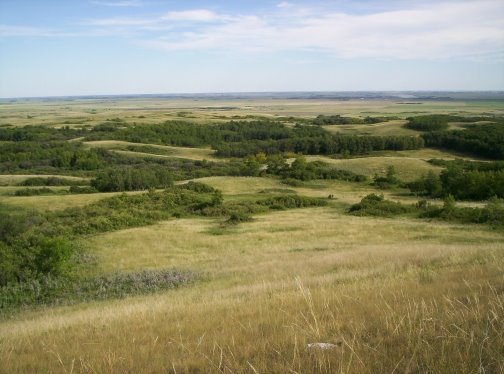
All those years growing up on my parents' farm, I could walk out to this hill just across from the house, just about any time I wanted. Almost looks like an aerial photo, doesn't it? But when I took this picture the other day, I was sitting on a rock. A small one. With my feet on the ground.

We kids used to go out to "the South Slopes," as we called this spot, in late winter when the sun was getting stronger and starting to melt the snow off a few small patches near the peaks of the biggest hills. I still remember the thrill of standing on that bare brown grass and earth, reconnecting with the ground for the first time in months.

We'd come out here to look for the first crocus buds, too.

When I walked out onto this hilltop a few years ago, when we had just moved back to the farm after fifteen years in the city, I was struck with a sudden realization. This view shaped the person that I am.

The other day, with my camera, I tried to capture a sense of the place, but it was quite beyond me. Perhaps if I'd had enough digital memory left for a video, I could have given you a glimmer of it. As it was, I got stingy with the pictures and didn't even zoom in on Arcola, so all you get is a blow-up of part of the scene above. This is my childhood view of the town where I now live.

It's just that band of dark green with some buildings showing in it, stretching across most of the width of this view of the distant "flats." I sometimes worry if I'll offend someone by saying "the flats," but our Arcola-Kisbey history book is subtitled "Mountain Hills to Prairie Flats," so I guess it's okay.

Arcola is about half a mile wide, I'd say. The road you can see in the middle distance is running from north to south away from the hills, and the next north-south road, one mile east of it, runs past the left end of the dark green area.

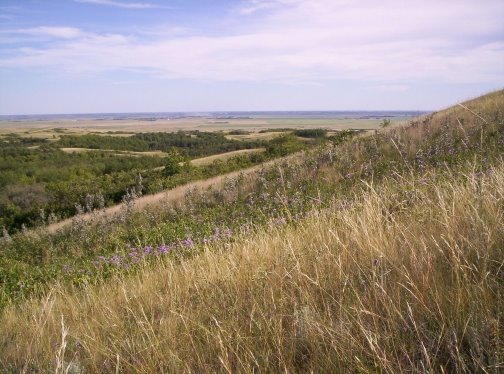
To give you a sense of how steep this hill is, here is another picture looking across its slope from a bit further east. You can tell by the horizon line on the flats - I didn't tilt the camera. (Okay, maybe a teeny bit. It's hard to stand up straight on that slope.)

And if you're thinking that's not steep, try climbing it. Or try browsing through some pictures of foothills. Most of the steeper slopes that you see are supported by rock formations. This is just glacial till. Here is a view of the "South Slopes" from the meadow below, looking west across their face.

If geology and ecology and botany bore you, skip along to some more pictures below.

I've been told that the Moose Mountains are a dead-ice moraine. When the last continental ice sheet was retreating, a chunk of the ice sat here and melted, dropping all the clay, sand, gravel, and boulders it contained in a great hummocky heap. If I recall correctly, the hollows are places where pieces of ice remained longer, so the earth materials settled around the edges of these lingering ice blocks, forming hills, and when the ice blocks finally melted out, they left holes that softened into hollows. All along the foot of the hills there are sand and gravel deposits, where streams running out of the melting ice slowed down as they entered the glacial lake to the south. The sand settled out of the water as it slowed. The silts and clays took much longer to settle out, so they were more-or-less evenly distributed across the lake bed, forming the flats.

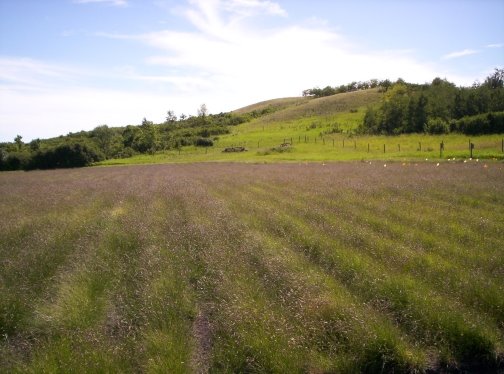
But we're still up in the hills, cradled in a meadow. I'll tell you a little bit about it. The crop in the foreground above is blue grama grass, a native species of short- and mixed-grass prairie, found most abundantly in dry upland areas. (Mom and Dad grow it for seed, for prairie reclamation projects.) This meadow was once a tame hayfield of yellow sweet-clover and smooth brome grass. Smooth brome was widely seeded as a hay crop and as a stabilizer for road ditches, and has taken over most of the "edge" area between grassland and wooded areas in our parklands. Any natural "edge" area - or "ecotone" as the biologists call it - is very important habitat to many wildlife species. My dad remarked that we probably don't know what "edge" used to be like here; brome grass has changed it, everywhere. In the photo above, you can see the extent of the brome grass, as the bright green area beyond the blue grama field, reaching to the edges of the trees and well up the slope of the hill.

Ah, but it's a part of who we are. I have a song about that, called "The Whispers in the Brome." Maybe some other day. I still have lots more pictures. Here's another view in the meadow.

And on the other side of the meadow, south of those "South Slopes," we have "The Big Woods."

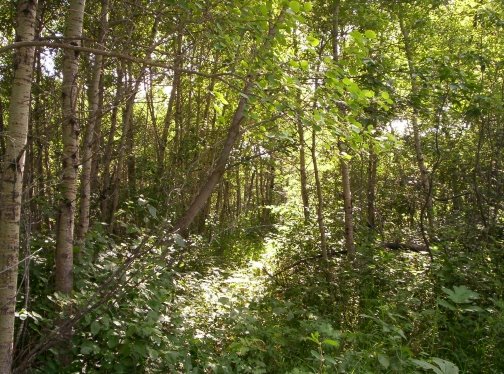
It's not the deepest, darkest view I could get, that's for sure. I love to thread my way through the bush and peer through beneath the understory for tiny flowers and mushrooms and such, but when it comes to taking pictures, I'm always drawn to the light. Besides, I was in the perpetual hurry that seems to haunt me these days, so I mostly kept to the not-so-natural trails.

The cattle had just been put into this pasture the day I rambled through it, so they hadn't grazed and trampled out the trails yet. Give them a few days. Then you can breeze through without having to dodge the stinging nettles, and maybe come away with only a couple of woodticks.

The "Big Woods" are a bit unusual in this landscape. They cover a broad low area that probably has water table fairly close to the surface, supporting black poplar (or balsam poplar, Populus balsamifera) and willows. Usually these species are found in smaller areas along the margins of sloughs and the bottoms of ravines.

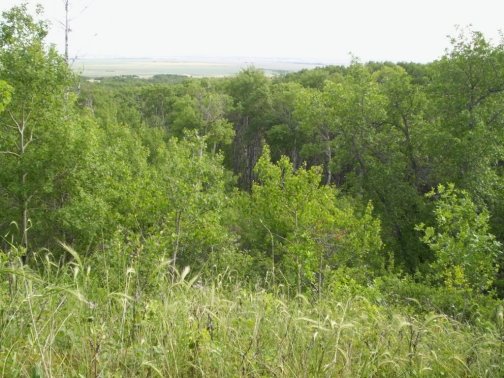
This is a view from the upper slope of a ravine at the west end of the "South Slopes." I didn't go down to the bottom. You can see a little bit into the shadows, but we're looking mostly at the crowns of the trees. The ravines are a different world. If it's hard work climbing the South Slopes, it's an ordeal climbing straight up through the tangle of thick underbrush on the side of one of these ravines. I've only done it a few times. Usually I seek out a good path before I start up. There is always a path along the bottom, where the cattle and deer and elk and moose follow the way of least resistance. There is good grazing and browsing there, too, even when the hills are dry, and in some of the deeper places there are springs.

Back up at the top of that slope, looking southwest, you can see the ravine running away through the center of the photo towards the flats. In the middle distance at the right side of the photo, you can see an area of more uniform grass cover. Again, it's an old field, now in tame pasture. Notice the contrast with the more diverse vegetation east of the ravine.

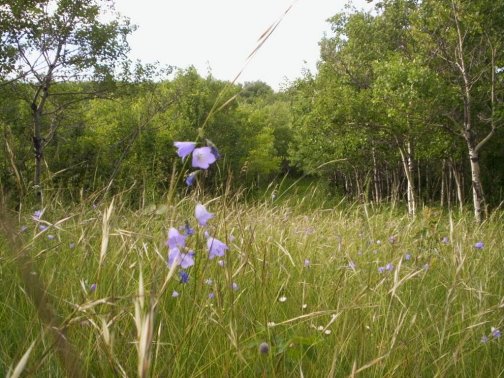
Time to turn for home. I did use a deceptive camera angle for this shot, getting down on elbows and knees to look through the needle-and-thread grass (Stipa comata) among the harebells (Campanula rotundifolia).

Oh, I still have more pictures, but it's time to go.

Sunday, May 14, 2006

My Mountain


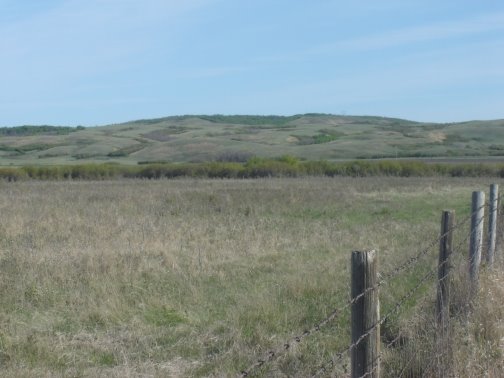
It's not really mine. A neighbour owns the land on the outwash plain in the foreground, and up the first main slope of the hills. Beyond that, all the way to the horizon and down the forested north slope beyond, the land is all part of my parents' farm, where I grew up.

I made a run out there yesterday morning to pick up a load of manure from the old cattle-feeding area, now a garden and orchard. It's almost twenty years since they wintered cattle there, and the manure has rotted down to black gold. I get to take as much as I want, and enjoy the scenery along the way.


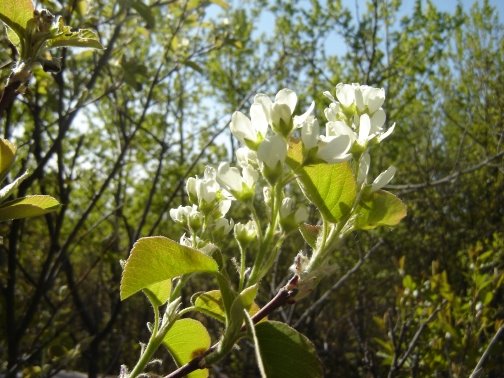
Saskatoon (Amelanchier alnifolia)
(above and below)


Western Canada violet (Viola canadensis)
(above and below)


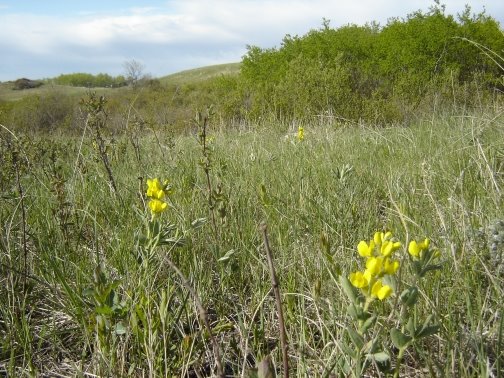
In case you didn't notice the crocuses, golden-bean (Thermopsis rhombifolia) makes sure you know that it's spring.

Thursday, December 01, 2005

Advent Thursday #1

Waiting.

The hunters seem to be waiting, waiting for tracking snow. Brian says the only orange hats he has seen are on fellow oilfield workers that don't want to get shot. The flurries we have had over the last few days have finally started to whiten the ground, but I don't know how much is needed for good tracking. When I hunted deer with my sister, we didn't do any tracking; we just walked through the hills until we saw one.

When I pulled into the farmyard yesterday, the ground was crisscrossed with rabbit tracks. They're snowshoe hare, actually, the "bush rabbits" that we see; I believe there may be some cottontails around but they're not common here. The hares have been waiting for snow. A couple of weeks ago, when we first had white everywhere, I noticed one calmly crossing under the six-foot-high catwalk where I was noisily tramping along. He(?) was hardly visible except for the gray rims and black tips on his ears. A few days later, that white fur was shouting for attention, against the brown and grey of the bush and fallen leaves.

In the open country there are jack rabbits (also a type of hare, rather than a true rabbit). I am wondering if the hares around town are jack rabbits, or snowshoe hares. I found the little field guide, "Animal Tracks of Western Canada" by Joanne E. Barwise, that we gave to Ruth about six years ago, and it looks like I should be able to tell by the width of the hind footprints. The dog and I spotted one in Brian's hedge the other day, or actually, hopping out of his hedge when we passed within a few feet of it. Otherwise I don't know if even the dog would have noticed it was there.

This morning as we walked on the trail between the brick ponds and the old railway grade, the dog and I spotted a vole skimming across the trail ahead of us. If it hadn't been for the leash, I think she might have caught it. This is a tough time for the wildlife, not only for the small things that need deeper snow for cover, but also larger animals, since the sloughs and dugouts have frozen over and there isn't yet much snow to eat for water. Plants are getting past the toughest time now, since it is staying cold and not stressing them with freeze-thaw cycles, but a blanket of insulating snow would be welcome for many. All things are waiting.

Back at the farm yesterday, among all the snowshoe hare tracks, there were squirrel tracks too, and a tiny paired row of tracks that probably indicated a shrew. In a remnant of an older drift of snow behind the seed plant, I noticed just a few pairs of weasel prints dimmed by the newer snow, but they are unmistakeable once you know them. On the lane past the barn, right up the middle, was the neat row of cross-shaped prints that testifies to the regal strut of a ruffed grouse.

I saw no deer tracks. In the earlier snowfall, I noticed plenty of deer tracks, and I don't recall that there was much else.