Showing posts with label how-to. Show all posts

Monday, May 11, 2009

Cultivating Our Roots

My Mom has published a beautiful book:


She wrote it from the perspective of a retiring seed grower, which means it can give the impression of a technical manual for a very narrow audience, but don't be fooled. I say, if you live in my ecoregion, you need to see this book.

Even if you will never grow anything, you might want to get acquainted with these plants. Consider this: they're your neighbours. They were here before you were, and likely will be long after. They might all look like "just grass" to you, but once you take a closer look, you may be astounded at the diversity in a tiny patch of unbroken prairie.

But here's the tricky part. Have you ever looked at a grassland in early June or late August and tried to find pictures in a field guide to match what you are seeing on the ground? Good luck. If you or anyone you know wants to learn to recognize some of the most common grasses and wildflowers of the mixed-grass prairies in the northern plains of North America, I say: start with this book. There are excellent photographs of multiple life stages of each plant, so you stand a good chance of recognizing your leafy new friend throughout the growing season - even when it's not so leafy. You won't have to wade through pages of obscure plants that you will never see, because there are only 62 wildflowers and 22 grasses included - only the most common species plus a few uniquely interesting species like buffalograss (rare in our region but common farther south in the short-grass prairie). As you learn the plants, you can also learn to recognize similarities among species in the same plant family, since the book is organized by families and includes identifying characteristics for each. That way, when you meet a plant that isn't introduced in the book, you may well be able to say, "You look familiar - aren't you related to..." and all of a sudden you will have a nodding acquaintance with hundreds of species.

And of course, if you want to actually grow these plants, whether as a seed business or just as a minimal-input alternative to a thirsty hungry lawn, you could benefit from the tips on planning and preparing a site, the illustrations to show you how your plants will look (even as seedlings so you can tell what not to weed out of your plot), the germination information, and tips and pictures to help you collect your own seed to get started.

I used to do inventories of the plant life on proposed oil and gas well sites. I worked with numerous floras and field guides, and through struggle and persistence, reached a point where I can look at most common prairie plants and just know them, no matter how small or shrivelled. But when I first started, and even in recent years when I was working very early in the growing season, I wish I had had this book.

Oh and did I mention that it's beautiful? People here were buying copies as Mother's Day gifts, just for the pictures of the their mothers' favourite flowers.

Yes, I'm proud of my Mom.

Wednesday, August 27, 2008

100 Species

I got this idea from CG. How many people can list 100 species that are growing in the area where they live?

I'm sure I could, but I often get paid to list species, so I'm not typical. Mind you, I do remember a field trip when I was a new biology student in university, and my prof was wondering how I knew so many of the plants we were seeing. Well, I just always wanted to know, so I learned!

Anyway, I am curious now to see how many plants I can name just by picturing my surroundings and what is there - how far from home would I have to wander in my mind to reach 100?

1) quack grass (I'm starting in our yard)
2) dandelions
3) Kentucky bluegrass
4) clover - which one? It's a Trifolium species, a white one, but I'd have to look up the exact name
5) common plantain
6) annual sow thistle
7) perennial sow thistle
8) chickweed
9) wild buckwheat
10) lamb's-quarters
11) brome grass
12) red-root pigweed (and there's another kind of pigweed whose name I have forgotten)
13) garden atriplex
14) doorweed (sorry, I don't know which one it is)
15) purslane or wild portulaca
16) there's another grass that I pull out of the garden before it matures enough to positively identify without a great deal of unnecessary fuss - I think it's probably foxtail barley
17) green foxtail
18) creeping bellflower (this is one of the plants in the flowerbeds that came with the house, and I just learned its name because it's on the invasive plant species lists I'm working with - there are also some kind of lily, an iris, a daisy, and something with variegated foliage, and a very pretty thing that I did know the name of once but it escapes me now - maybe a columbine? I've just never taken much interest in the ornamentals)
19) lily-of-the-valley (I did know this ornamental somehow - maybe because it's poisonous)
20) Maltese cross (another ornamental that I know, because I came across the name and it intrigued me)
21) desert saltgrass
22) caragana
23) chokecherry
24) gooseberry
25) saskatoon
26) American elm
27) Manitoba maple
28) green ash
29) lilac
30) honeysuckle (though I'm not sure which one - those ornamentals again!)
31) peppers
32) tomatoes
33) onions, chives, and garlic - are some of these so closely related that they are counted as a single species? I don't remember
34) swiss chard, beets, and spinach - if I recall correctly, these are all close relatives too
35) parsley, parsnips, and carrots - another set of close relatives
36) lettuce
37) beans (wax and fava)
38) peas
39) lots of cucurbits - cucumbers, zucchinis, pumpkins, and spaghetti, acorn, and butternut squashes
40) potatoes (I'm out of my own yard now, across the street at Garth's brother's place, where we keep the other half of our garden)
41) dill
42) sweet corn
43) rutabagas
44) broccoli
45) raspberries
46) strawberries
47) spruce trees - I wonder exactly what kind?
48) ox-eye daisy
49) dame's-rocket - these last two are more ornamentals that I just learned because they are on the invasive species lists
50) Hmm - one more to hit 50 before I leave the two yards that we live in - there must be one more. Have I seen goat's-beard here? Or - yes! There is a cotoneaster bush, or there was, but they may have killed it when they ground the stump of the big elm in front of the house last month, but I'm going to count it.
51) blue grama grass (no, I haven't gone way out in the prairie yet; this is between the sidewalk and the street, just next door)
52) bastard toadflax (I hope I got that name right - it's another one I learned from the invasive species lists - this is growing wild at the edge of the pavement)
53) butterfly-weed or scarlet gaura - a farmer friend of mine found the scientific name titillating, but maybe I pronounced it wrong - go look it up if you're curious. (The PLANTS database is handy for that, and if I used it I could get all these names right, but I'm testing my mind here.)
54) weeping birch
55) poplars and/or cottonwoods - I don't know the horticultural species, but I know there are a bunch of them in various nearby yards, and I'll get to our native species later (if I don't hit 100 before I get out of town)
56) crabapple
57) rose (I do admire the white shrub roses in some yards nearby, so much so that I tried to root some cuttings last year, and just today I picked some of the dry hips to see if I would have more success with the seeds)
58) seaside arrowgrass (I'm away from the street now, wandering in my mind along the drainage ditch behind our yard)
59) cord grass (and I know there are two species here, and I know that one has awns and the other doesn't, and one of them is called alkali cord grass so maybe it's the one that grows in the saline ground along that ditch)
60) cattails (in the old brick ponds behind our yard)
61) wild licorice (just beyond the brick ponds)
62) kochia - I just remembered that one, it's in our yard too - and I thought I might like to work as a weed inspector! Ha! I'd have to clean up our own yard a bit first! But seriously, if I could work from the angle of helping people learn more about what's growing on their land, not just as the enforcer with the right to enter onto private property, I could enjoy that, and in some places I think the inspectors do work from that angle
63) oh, and I'm sure we must have some black medick in the garden too
64) and probably some yellow sweet-clover
65) alfalfa - now I'm beyond the railway, or I should say beyond the old railway grade, out looking over the hayfield towards the airstrip that some locals call the airport
66) willows - that's down beyond the airstrip, but there are some ornamental willows in town too - and don't ask me what kind of willows they are!
67) sedge - I'm sure I could find a sedge somewhere along the roadside where I walk south of town; for sure there must be some down by those willows - and again, don't ask me which sedge!
68) northern wheatgrass (okay, I gave up and went home in my mind to the farm five miles from town, where this challenge gets so much easier)
69) western wheatgrass
70) needle-and-thread grass
71) western porcupine grass
72) awned wheatgrass
73) western red lilies
74) smooth camas
75) wild blue flax
76) gaillardia or blanket-flower
77) black-eyed susan
78) prairie crocus
79) June grass
80) prairie cinquefoil
81) white cinquefoil
82) three-flowered avens
83) ground-plum
84) snowberry
85) silverberry or wolf willow
86) narrow-leaved meadowsweet
87) fringed loosestrife
88) pincherry
89) beaked hazelnut
90) high-bush cranberry (I want some hazelnut and high-bush cranberry bushes for the yard here)
91) paper birch
92) white poplar (told you I'd get to them) or trembling aspen
93) black or balsam poplar
94) Western Canada violet
95) poison ivy
96) stinging nettle
97) yellow avens
98) heart-leaved alexanders
99) alum root
100) Indian-pipe (a non-photosynthetic plant - I had to think of a distinctive one for my 100th)

And there are many more. But CG's list is much more impressive, because you can tell that she knows a lot more than just the names - she knows which ones to eat and which ones to use for healing and more.

And if you find all this overwhelming, there is a book I want you to meet. (I wish I had known about this book back when I knew mostly just the showy wildflowers that I had taught myself from the pictures in our field guides at home, and I was sent out with a few floras - floras are plant books with detailed botanical descriptions and sometimes no pictures at all - to see what I could find growing on proposed oil well sites, in case something rare was there.) Thomas J. Elpel's Botany in a Day gives you patterns to look for, just a few patterns to learn so that you will know the major plant families of the North American interior plains. That means you can jump to the right part of the flora or field guide right away, instead of struggling through a botanical key or flipping through the pictures. And you will have hooks to hang your knowledge on as you meet new plants, instead of just an endless parade of names and images to remember. And most importantly of all, if you learn from Mr. Elpel's book, you will be learning plant uses as you go, because he includes information about the properties shared by plants in each family.

And CG - thanks for getting me blogging again, if only for today. Tomorrow I will be back out in the farmland of southeast Saskatchewan, listing plants for pay, and reinforcing my conviction that I'd rather grow plants to eat and not need the pay so much . . .

Monday, July 23, 2007

If You're Asked to Play the Vice Regal Salute . . .

. . . you'll be glad to know that there is downloadable sheet music, including ensemble parts for C, Bb, Eb and F instruments, at the website of the Lieutenant Governor of Saskatchewan.

The Arcola Community Band will play the salute at a dedication in Alameda on August 4th, as well as marching in the parade that morning. Wish us well, or dust off your horn and join us!

Saturday, April 07, 2007

A Three-Year Bible Reading Plan

I found a good one!

A few years ago I went looking for a plan to read the bible all the way through. I know, there are many, and I had already followed one of them. It gave me a very different perspective on the body of religious and spiritual literature that undergirds so much of our Western culture. Some time had passed, though, and I wanted to go through it again and see what else I might learn. This time I was looking for a plan with a difference: I wanted the reading to be spread over three years instead of one, and to loosely follow the Revised Common Lectionary which prescribes the Sunday scripture passages used in many churches. Since the last time I read the bible through, my scripture reading had been mostly limited to the Sunday passages plus a bit of browsing and cross-referencing when pondering some idea or preparing the odd sermon. Again and again I noticed how the Sunday passages omit context. I wanted something to take me a bit deeper, to fill in those gaps, and why not combine that with my impulse to read the whole collection of books again?

Aside: If you're wondering why I keep talking about a "body of literature" and a "collection of books," it's just that the term "bible" comes from a word meaning "little books," and I like to keep that in mind. Whatever holy inspiration may have worked to bring those books together, the bible still originated as a compilation.

Anyway, when I first looked a couple of years ago, I did find a plan similar to what I had in mind, but as I recall, the connection with the Sunday passages was looser than what I had envisioned. I let the matter drop. It came back to mind recently when I realized that we are working through "Year C" of the lectionary right now, and a new cycle will begin next Advent. I thought I might have to get started making my own plan, but it looks like somebody named Gloria has already done it. Thank you Gloria!

Wednesday, January 17, 2007

Just Air

I'm no expert in the kitchen, but as I've spent more time there, learning by doing, reading, or phoning Mom, I've realized that my skills are greater than I thought. While Mom was feeding and calving out cows, melting snow for wash water, helping put up hay and build a house, and shooing the three of us kids outside, she still managed to teach me some fundamentals.

One of these is the power of air.

There are very few cleaning products in my kitchen. Strictly for cleaning, there are just two: dish detergent and hand soap. For both cooking and cleaning, of course, there's baking soda and there's vinegar. I don't use anything labelled "anti-bacterial" or "kills 99% of household germs." For disinfection, I rely on a few simple habits and the power of air.

Bacteria and other maligned and mistrusted microbes are living things. They need food, and they need water. Take away one of these needful things, and they won't grow.

Simple washing takes care of the bulk of it, by removing most of the material that could be food for microbes, and sending many of the microbes themselves down the drain at the same time. Still, there are undoubtedly a few microbes left clinging to dish and sink and counter surfaces, no matter how clean those surfaces look.

It only takes one bacterium, lingering on a surface when the next round of food arrives, to grow and multiply into a problem. It might be a smelly problem, or it might be an invisible, scentless, tasteless, toxic problem. How do I dare live without powerful disinfectants?

I don't. There is a very powerful disinfectant all through my kitchen, all the time: air.

All I need to do is make sure it has a chance to work.

When I wash dishes, I set them in a rack to dry, and make sure they are not nested closely or holding any puddles. When I put them away, I check to be sure they really are dry - no films of water get trapped in the stack of plates.

When I store jars and water bottles, I leave the lids loose. If you tighten them, you may trap just enough moisture in there to keep some microbes alive, and when you open the lid weeks or months later, there will be an odor. (I'm lucky to live in a dry climate - I don't know if this trick would work where it's humid.)

I launder the dishcloths often, but if I'm going to reuse one before laundering it, I rinse it (to take away the microbes' food) and spread it out over the faucet so it will dry quickly. Watching how others treat the dishcloth made me recognize my own habit of pursuing dryness. Sometimes they would leave it in a damp mound in the bottom of the sink; once someone hung it with its edge trailing in dishwater left to soak! Didn't they know it would never dry out that way? Did they even know the reason for letting it dry?

My mom got us through years with no running water and no refrigerator, with never a single case of food poisoning. She was careful with leftovers, holding them in a somewhat cooler spot in the house or sometimes in a pail dug into the ground outside and covered with an insulated lid, and using them up quickly. She did her canning in a pressure cooker, following instructions to the letter, and never used any canned food that seemed even slightly off. But there were subtle things she did, too. Without even realizing it, I picked up her habits of keeping things reasonably clean and getting them thoroughly dry between uses.

I can never remember how to make a white sauce, though she recited the three ingredients to me often, but that's okay, it's in the book she gave me for our wedding. What's more important is the stuff I didn't even know she was teaching me, the stuff I will never forget.

Thursday, January 11, 2007

How to Get the Dishes Done

Remember the Voyage of the Dawn Treader, and the Monopods? Remember how they did the dishes?

Sadly, our dish-washing system has often resembled that of the Monopods: wash the dishes before dinner, to save time afterwards. Actually we tended to wash them before dinner because of all the time we had already saved after lunch, breakfast, and yesterday's dinner by just piling dishes on the counter, until there were no clean dishes left.

We adults also saved time (and peace and quiet) by just washing the dishes ourselves instead of arguing with children about the importance of the task. But like the old line my Dad used to sing in auction-sale season - "We'll save a lot of money saving money we ain't got" - we just couldn't seem to save enough time for the work by working. So, time after time, the dishes piled up until they spilled over into other parts of our lives. Then something after dinner would get cancelled and the counter would get cleared off - for an evening.

This Christmas we finally stumbled on the simple, elegant solution. It arrived in the form of a four-place setting of simple, elegant (to my eyes) Corelle Sandstone dishes. I found the set in the Sears Bargain Centre, missing one dinner plate, and thought I'd give it to a relative who didn't have enough dishes for serving meals to guests. Then I took a peek inside the box and coveted those dishes for myself.

So I bought the four-place setting (rounded out with a replacement plate from open stock), brought it home, set the plates and cups out on the table and admired them . . . and gave away our twelve-place setting of white-with-blue-clip-art Corelle instead. It's a bit chipped and stained from fifteen or so years of daily use, but the gift was graciously received. Meanwhile, back at our house, the miracle appeared: a clean counter.

Twice a day.

I was planning to buy a couple more sets of Sandstone, to get life back to twelve-of-everything normal, but life-with-only-four is much better than normal. Maybe we'll even start getting out the real china (found at a garage sale before we were married) if we have to set the table for more than four. Or we could always borrow our old Corelle back for parties . . .

Friday, November 10, 2006

God Save the Queen

If you're asked to play "God Save the Queen," and you can't find the music right away, fear not. Chances are you do have it, under another name. Try looking for "America" or "My Country 'Tis of Thee."

Your next problem might be to shift it into a singable key. Many books offer it in the key of G, which confronts the singers with a series of D's and that last phrase lunging to an E. No trouble for a trained singer, but as public singing has dwindled in recent decades, so has the comfortable vocal range of most assembled groups. CyberHymnal has a score in F, quite accessible to most singers.

Since the anthem is used by tradition rather than any legal proclamation, I see no problem of protocol with shifting the key. In fact, while the Royal webpage for this anthem has a recording in the key of G, at the Canadian Heritage page you will hear it in the key of B flat.

However, for people who enjoy (or suffer from) absolute pitch, or for those who have this anthem firmly in their muscle memory, even a one-tone drop might be a problem. What do you think? F or G?

Friday, September 01, 2006

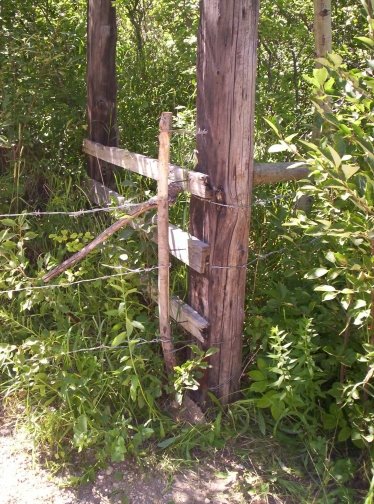
The Gate Post

. . . or, How to Open and Close a Wire Gate.

The closing part is the most important. Never open a gate that's meant to stay closed, unless you're sure you'll be able to close it again. It's like knowing how to stop a car before you try starting it.

Some people say "Always close gates," but I say, always leave gates the way you found them. Even if you come upon a gate lying open, and you can see the cattle coming, don't be too sure there aren't some herders behind those cattle, who would be more than a little annoyed if they finally got the herd up to the opening and found that it wasn't.

On the other hand, even if you can see the whole pasture and there is no livestock in sight, don't be too sure it would be okay to leave the gate open. Just picture the above-mentioned herd moving along the roadside ditch, heading for the home farm, only to come upon your left-open gate and turn aside into the wrong pasture.

If it was open, leave it. If it was closed, close it.

Unfortunately, there are several factors that may make a gate harder to close than it was to open.

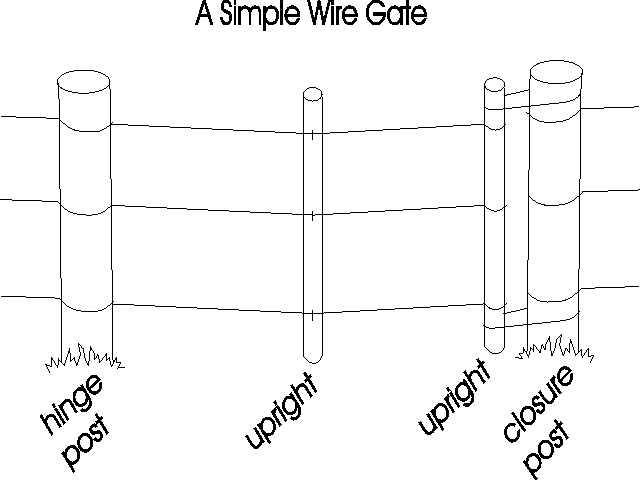
One is fatigue. If it's all you can do to slip that wire loop off the gate upright, your exhausted arms will have nothing left for working it back on.


Another factor is the tendency of wire gates to tangle themselves up the moment their tension is released. Then when you try to close the gate, it can seem suddenly several inches shorter than the opening it formerly filled, due to wires being hooked on their neighbours' barbs, uprights being angled out of position, and so on. I have a habit of keeping a firm hold on that gate post as the loop comes off, and then, as I swing the gate open, walking with an outward lean and hanging my weight against the pull of the gate, much like a dog straining at a leash. This keeps the gate straight and upright with no risk of tangling. Of course, if I'm alone, I have to lay the gate down to move my vehicle through the opening, but this can be done carefully and neatly to minimize sagging and tangling of wires.

Once you have the gate back in position, be sure that all the uprights are standing more-or-less, well - upright. A lean to one side or the other can add a surprising amount of resistance when you are trying to pull the gate tight. I have found that I can usually jump them into position with a sharp upward jerk (or two) on the end upright.

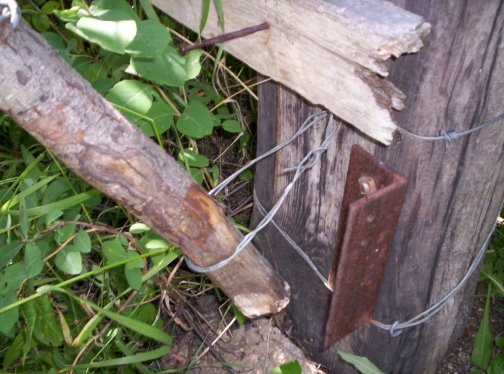
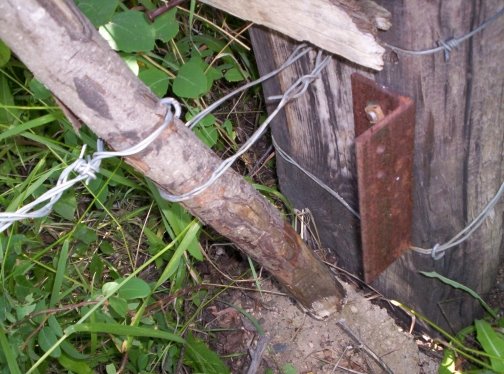
Now here's a more subtle trick to use when that top wire loop just doesn't seem to reach over the end upright: pay attention to the position of the bottom wire loop. If it's angled downward, because the upright hasn't been pushed into it all the way, then it will be pushing the upright higher, so the top wire loop has to reach higher to clear the top. The gate will also be out of alignment, so that you have to stretch it even tighter. I usually put the upright into the loop and then straighten it up some, and work that bottom wire loop upward with the toe of my boot until it's lined up well.
Bottom loop angled downward - upright (left) not in far enough

Better

If you still can't get the gate closed (and the cows are coming, and people are shouting, and oh-no-there's-the-bull!), don't worry, there's still another trick to learn. This one involves using your own body to best advantage.

Chances are, your first attempts involved pushing the upright closer to the closure post. Maybe you had one hand on the upright and one on the closure post, trying to bring those two hands closer together, and as you got more desperate, perhaps you tried to guide the wire loop with your teeth.

Try this instead.

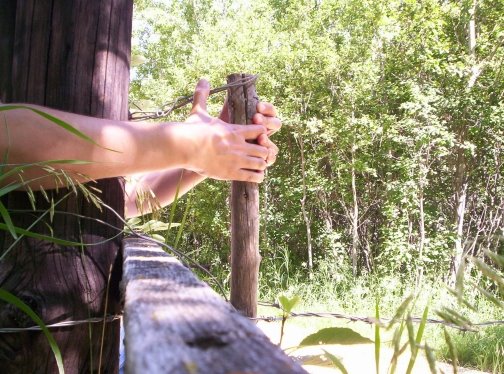
Get on the fence-ward side of the closure post, shoulder up to it, with your arms reaching around it to grasp the end upright and pull it straight towards you. Your thumbs can guide the wire loop into place without struggle or fear of pinching.

Whew! It's closed.

Apparently this stranger, struggling to open the gate, hasn't heard about that last trick. We'll just let her wear herself out and go home.

If you've been paying attention, you can easily see how some of my tricks for closing gates will also help with opening them. But I won't spell any of that out here. If somebody happened to use my advice to get a gate open, and then left it open, I might have a farmer after me with a post maul. And the more gates that are carelessly left open, the more farmers just tighten up those wire loops a little more, so that my little tricks aren't enough anymore - you also need the farmer's brawn, or another advantage which I won't mention here.

A few other notes about gates:

If you find a gate that is closed with a length of rope or chain wrapped around the closure post and the gate upright, be very careful to note how it is fastened before you release it, so you can get it back the same way. It can be a bit easier to manage than a wire loop, since you can get it wrapped loosely and then pull to cinch it up, but you may not get it quite as tight as it was to start with.

If you want to make a wire gate easier to close, consider a strap-steel lever device, like the one shown here (pdf).

While I was looking for illustrations, I found an interesting article about different kinds of gates. I like the looks of the hinged wire gate, with the rigid diagonal, that uses the weight of the gate to pull the wires tight. And the one-way wildlife gate, that lets trapped deer escape from an orchard.

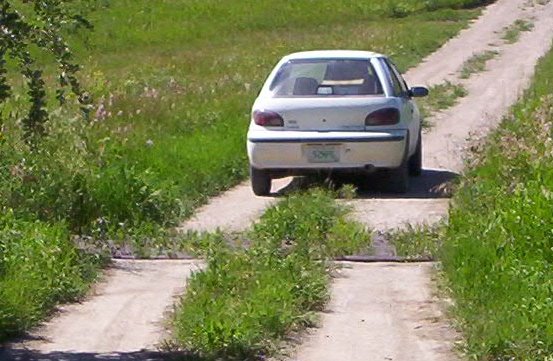
Of course, the easiest kind of gate (if you're driving something with four wheels) is the cattle guard. A steel frame supports a series of pipes across the road, level with the road surface, so that there are gaps between the pipes, and an empty space underneath. Vehicle wheels easily span the gaps, but cattle hooves are too small, and cows don't usually dare to try to balance on the pipes. We used to play on this gate while we waited for the school bus, balancing on one pipe at a time, or bracing a boot sole across from one pipe to the next. I've seen Garth ride his bike straight across it, but I never quite found the nerve for that. It's not the best picture, but you can see the plants poking up between the rusty pipes. There are better pictures in that article I mentioned above.