Showing posts with label direct use. Show all posts

Thursday, December 29, 2011

Top Ten Things You Can Do for the Environment

It's the time of year for top-ten lists.  Here's mine:

  1. Grow a garden.  Yes, you.  This has finally started to turn up on a few lists, long overdue, but it's usually way too far down the list.  Don't have a bit of land?  (Are you sure?  Think small, even a planter or a window box.)  Help a friend.  Get a community garden plot, and again, maybe go together with a friend on this.  The most important tip for a beginning gardener: start small.  It might seem insignificant, but you will be surprised at what you can produce.  And transportation of fresh produce is a big part of our ecological footprint, so a successful small beginning at gardening may have just as much impact as any other green project you could do. 
  2. Take up hunting or fishing.  Yes, you.  Yes, kill something.  Do it close to home, and you will have to learn about the natural habitats of your own area, where they are, what sustains them, and what threatens them.  They need you.
  3. Eat what you kill.
  4. Eat smaller portions of meat: a piece about the size of your palm and the thickness of your pinkie finger is plenty, even with all that vigorous gardening and hunting you will be doing.
  5. If your hunting and fishing doesn't fill your reduced meat needs, look for domestic meats that are grown locally in harmony with the natural habitats you learned about in #2.  In my area, that means range-fed beef, which uses self-guided cow-power to harvest and fertilize natural grassland instead of plowing it up and using fossil fuels to cultivate and fertilize grain crops.
  6. If, after all this new recharge time you are spending in your garden, on the trail of a deer, or on the water with your fishing rod, you still feel the need for a holiday from your life, take it close to home.  Check out nearby parks, festivals, galleries - try your local tourism agency if you need ideas.  Try something different: a bike tour, or paddling lessons; a retreat to learn about the enneagram; a music camp where you can learn to play an instrument.
  7. Buy less, but when you do buy, spend more.  Buy quality, to last a lifetime.  Help the economy shrink back so it fits within the biosphere instead of mining the Earth.
  8. When giving gifts, show your caring through the time and thought you put in, instead of the dollars.  In my family, for the last couple of years, CHRISTMAS stands for Consumeable (or Cookies), Homemade, Recycled (if you're not using it much but someone else would, why not?)... and I have been trying to extend the acronym to include Indirect (a gift to charity), and then the rest of the letters make an excuse for buying something Specific to that person and Terrifically Magically Awesomely Spectacular... such as the lightweight plastic trombone we found for my Mom to help her continue marching in parades well into her 70s.
  9. Don't have time for all this?  Do it anyway, and with the money you save, quit working.  Give up that second income, or the overtime.  Change jobs if you need to.  Take back your life.
  10. Tell your local political representatives what you are doing, and why.  Destroy their argument that we can't make changes because the public won't change.  Change, and show them.

Friday, June 22, 2007

Illich and My Garden

I found an archive of writing by Ivan Illich. I love his analysis of the number of hours put into owning and operating a car in a year, and the mileage gotten out of it. Divide the miles by the hours and you get about five miles per hour. Might as well walk!

This summer I have been resorting to a lot of powered and packaged conveniences in hopes of completing a renovation project quickly, before winter comes swirling in through the gaping hole that will soon be cut in the house wall. Ultimately that hole should let in a lot of sunlight and help keep the house warm, but only after a lot of framing and roofing and installing of windows and such. I'm in a hurry, and Dad has the tools, so I'm using them.

But I couldn't give up my garden, not even for one season. This winter I tried out the Ecological Footprint Calculator and realized that the environmental impact of food transportation is even larger than I thought. So I garden, stubbornly. There are some pictures over at my garden blog. I used to call it The Daily Bed, but now it's The Occasional Bed - still just as many beds, but less time talking.

Thursday, June 07, 2007

The Science Commons

Oh, at last! When I was a biology student, online publishing of scientific literature was just hitting the mainstream. I was excited to think that, in a few years when I was out in the world somewhere away from a university library, I would be able to browse through all this vast array of scientific knowledge and delve deeper into anything that intrigued me.

But even before I left the sheltered wonder of the university, I was quickly losing sight of my dream behind a wall of insurmountable subscription fees. No individual of modest means could possibly aspire to maintain subscriptions to more than a handful of journals. Yet important research papers are scattered across literally hundreds of journals, making it virtually impossible to stay broadly informed without membership in an institution that can afford the subscriptions. And where do those fees go? How could it possibly cost the publishers that much to put a journal online? There must be some enormous profits involved here.

Today, as I dreamed, I can browse through the entire vast array of newly published scientific literature right here at my computer in small-town Saskatchewan. But as soon as an article catches my interest, I come up against that subscription wall. Sometimes Google can find me something similar, but if I want the real thing, I have a choice between an absurd per-article download fee and a two-hour drive to Regina to read it at the university library.

Now, at last, there is an effort to change that. The Public Library of Science is offering a new model that makes scientific literature freely available to all. The Creative Commons website has an interview with one of its founders, Berkeley biologist Michael Eisen, that lays out the rich potential and urgent need for this approach.

I almost want to be a scientist again.

UPDATE: SimplyTim has suggested another repository of free literature, in the medical and life sciences: PubMed Central. I took a quick glance down the first page of the journal title list, and decided I don't dare dig deeper there until the snow flies. Thanks Tim!

Thursday, May 10, 2007

Real Gardening

There's a fine new reality-check blog post about gardening over at the Free Man's Garden. If you haven't met Eleutheros yet, oh, you should. Check out his advice on eating, too, at the Free Man's Table, and if you get to wondering how far removed he is from the dominant society, the archives of his original blog will tell you just How Many Miles from Babylon. A few hours at his place might shake you up. They might give you some real hope, too: not a vague hope for greater equity and unity and efficiency and all that, but a clear path to actually reverse your own share of the worrisome world trends. No more hand-wringing, friends; let's roll!

**********

Yes, I'll admit I'm a fan. And I'll admit that I've been spending too much money on garden gadgets and supplies. And as I ate my packaged breakfast cereal this morning, I thought about how I've backslid from eating mostly bulk-purchased whole foods. Right now, though, my focus is getting the garden in so we don't backslide too much in that endeavour. Next comes the renovation for a greenhouse area and passive solar heat - a step forward. "When the work's all done this fall," as they say, there will be time for more conscious cooking and eating.

One small triumph: today I am slow-cooking the last buttercup squash of our crop from last year. All I did with the squashes was to bring them into the porch, which gradually cooled through the fall to about 5-10 degrees C. All winter they decorated the steps in there, and most of them kept beautifully. And now we will be losing the porch to make way for our sunroom. I hope the new cold room that we tucked into the design will work as well.

Friday, December 08, 2006

Counter-Intuitive Bad News

Here's a new finding that goes the exact opposite direction from what the climate optimists have been saying. You've probably heard the argument that CO2 is plant food, so rising CO2 means more plant growth, which means more food for humans and everything else, and at the same time, controls the rise in CO2 levels. You probably already know some problems with that argument: plant growth is obviously not controlling CO2 levels, and CO2-fertilized crops may actually be less nutritious.

But here's the new problem. Satellite studies indicate that microscopic plants in the ocean grow slower when the ocean gets warmer.

That startled me. From my biology background, I know that most biological processes speed up with temperature. Heck, just from living through a cycle of the seasons here, I know that plants grow faster when it's warmer. So why do these tiny plants in the ocean grow slower? From the news release at Oregon State University:
When the ocean surface warms, it essentially becomes “lighter” than the cold, dense water below, which is loaded with nutrients. This process effectively separates phytoplankton in the surface layer - which need light for photosynthesis - from the nutrients below them, which they also need for growth.
Well, so what? Aren't trees more important than these phytoplankton that we can't even see with the naked eye? Back to the news release:
Despite their microscopic size, ocean phytoplankton are responsible for about half of the photosynthesis on Earth, a process that removes carbon dioxide from the atmosphere and converts it into organic carbon to fuel nearly every ocean ecosystem.
Ouch.

Bad news, yes. Or is it? I'd say it's better than no news. If phytoplankton dies in the ocean, and nobody hears about it, it still dies. How about using this news as fuel to fire up your determination to walk instead of driving. Try a toboggan for the groceries, with a picnic cooler on it to keep the bananas and lettuce from freezing on the way home. Or grow some sprouts instead of buying lettuce, and check out those new garden catalogs for some fruit trees and berry bushes to plant next season. Insignificant? Consider this: a lot of people say our food in Canada travels an average of 2500 km to get to a dinner plate, and I've heard some estimates as high as double that.

And pass the word along to a climate optimist. Gently. They don't like to hear this stuff - and can you blame them?

Monday, December 04, 2006

The Disconnect

Here on the plains south of the Moose Mountains, there are two main industries: agriculture and oil. When you need money to keep farming, you go work on the rigs.

There are some proud farmers and ranchers who get by with what they can earn from their land, and sometimes fight a losing battle to keep the oil wells off it. There are some people here only for the oilfield work, who have little or no connection to any farm in the area. But for many people, the two industries have formed interwoven strands of their lifestyle for generations.

Recently I have heard of people quitting farming to work full time in the oilfield. One said his only regret was that he didn't do it sooner. Others carry on, quite literally using their oilfield income to keep their farms going.

The problem is the rising cost of just about everything except farm produce. A farm can't be run as a stable business if the costs keep going up while the revenue stays flat. Some farmers have been coping by expanding their acreage, spreading some of their costs over a larger area of production and hoping the per-acre costs don't overwhelm the per-acre revenue. How long will that hope hold?

And why the squeeze?

I just finished reading an overview of similar problems in Montana (in Part One of Jared Diamond's book, Collapse). Diamond related a story to highlight the difficulty farmers face. At one time, if a farmer wanted to buy a truck, he would sell two cows. Now, to buy a truck, he must sell 25 cows.

To an urban person accustomed to inflation, that might not seem wrong. Prices go up. But why hasn't the price of cows gone up? Sure, the urban cost of living goes up, but so does the average wage. Back on the farm, when the cost of living and of farming goes up, what is the farmer to do? He can't just grow more cows on the same amount of land.

Reflecting on this, I realized that the problem is built into the foundations of our economy. Because our economic growth is fueled by oil (and coal and natural gas) and not by growth in biological production, there is a disconnect between the performance of the overall economy and the returns to agriculture. If the overall economy was dependent on biological production for its fuel, then the price of biological products would keep pace. Grain would be valued for the energy stored in its carbohydrates; that value would be reflected in the price of a grain-fed cow; and a farmer selling two cows could still get the same return in material goods as his father did. Instead, fossil fuels are used to squeeze more and more biological production out of less and less human labour, holding the price of those biological products low. Meanwhile all the rest of the economy is allowed to surge along on the power of fossil fuels, effectively disconnected from the reality of biological limits - for a while.

In Montana, the problem is much more acute than in this area, because land prices are rising steeply due to demand for homes and acreages in the beautiful mountain landscapes. Farmers cannot expand their operations to spread costs, because the land costs more than they can earn back by farming it, even over a lifetime. In the desirable mountain valley areas, farming is on its way out.

When I read this, I remembered Eleutheros's post, "Unlike Coin," and wondered whether a farmer who focused on direct use - growing food and fibre for his own needs rather than for the money it could earn - could persist in those Montana mountains. Rising property taxes would be a challenge. That might be overcome, but what about estate taxes? How would a direct-use homesteader pass that homestead on to a child?

How ironic that we have structured our economy to grow and grow and grow - at the expense of growing food. We are running an enormous gamble, that the unknown jackpot will contain some sort of unlimited supply of clean energy (pdf), that we will win it before the existing energy sources become inadequate or intolerable, and that energy alone will be enough of a foundation when we finally turn our attention to coping with the limits of soils, water, oceans, and climate.

UPDATE: Eleutheros has a new post about our response to limits - depressing or bracing, depending on how you want to take it.

Thursday, October 19, 2006

Nettle Harvest


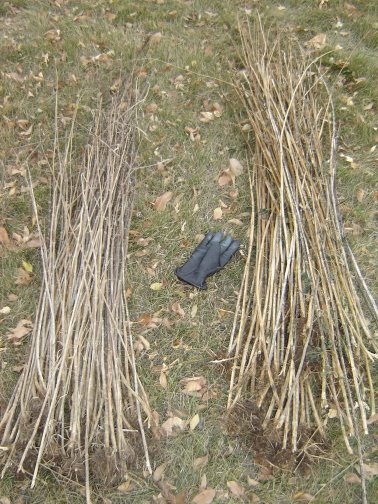
Yesterday morning I was out to the hills to help my dad along with his new musical ventures: learning to play the C melody saxophone, and doing more with the guitar. After loading him up with things to practice, I strolled out to their garden and pulled a bunch of nettle stalks from the side of the weed heap. I tried breaking one underfoot and cracking apart the pith walls to see if I could find the rumoured fibers for spinning into nettle thread or yarn or whatever it would be called, but I didn't have much success. Now I am hunting more references to glean whatever tricks I can. Perhaps the stalks will need to be retted, but I'm told the odor of that process is not acceptable indoors, and water outdoors is frozen over now. I may be storing my nettle bundles until spring.

Nettles are very noticeable, and that may explain why I used to think of them as abundant. Once I set out to gather them, I decided they're not so common after all. I know of specific places where they grow thickly, but they're not the sort of plant that you see dotted here and there through a wide variety of habitat. Now I'm thinking again that I should plant some here in the yard. (That would really raise some eyebrows, no?)

Aside from their fiber content, nettles are useful as a highly nutritious early spring green. Just boil or steam them a little to neutralize the sting.

Less directly, but perhaps more importantly, nettles have value to us humans as a food plant for butterflies. Today I found a new report on the Status of Pollinators in North America, which outlines another of those slow emergencies that will probably not get much notice until it's too late. Perhaps it will never get much notice, and future schoolchildren will marvel at the fantastic stories of a time when gardens didn't need hand pollination, and the world was home to six billion people, and candy bars were made with real chocolate (pdf).

Now for the obligatory cheerful closing note about things you can do to help. The Pollinator Partnership, at www.pollinator.org, has a long list of online resources, with everything from research about native bees, to pollinator-friendly practices for golf courses, and of course articles about gardening for bees, butterflies, and hummingbirds.